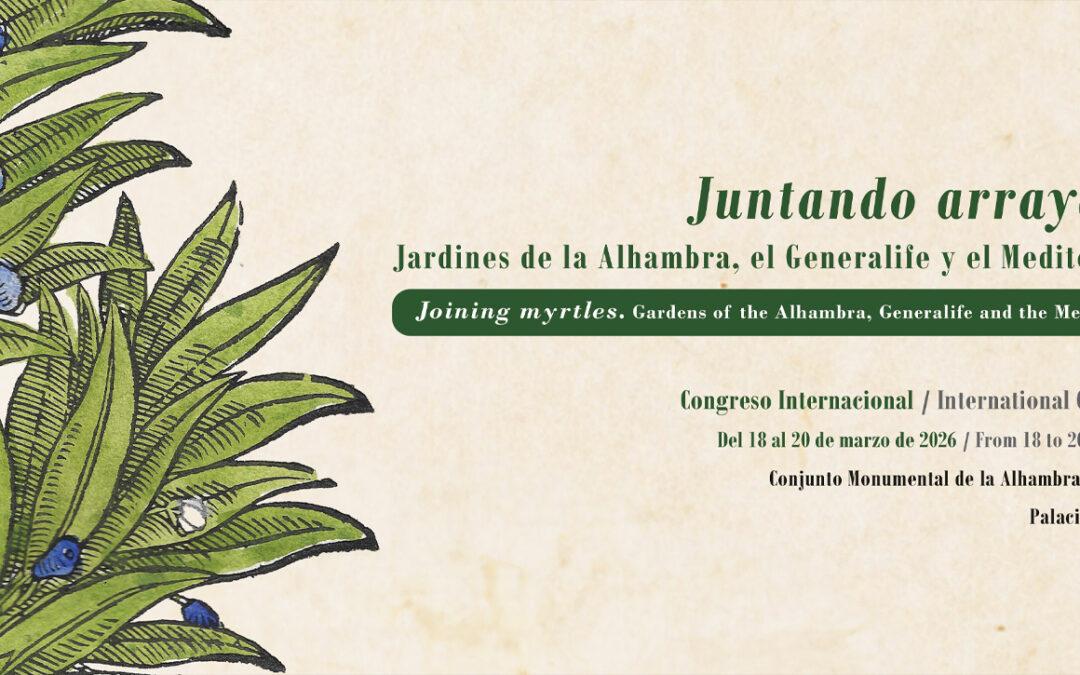
The gardens of the Alhambra and the Generalife—considered among the oldest cultivated palace landscapes in continuous use worldwide—will be the focus of an international scientific congress held on 18, 19 and 20 March 2026 in Granada.
The event is organized in connection with the exhibition “Gardens of the Generalife and the Alhambra. The Miracle that sprang from Water,” promoted by the Alhambra and Generalife Council and the Andalusian Public Foundation El legado andalusí.
To ensure the highest scientific standards, the congress includes in its organization Dumbarton Oaks, a prestigious Harvard University research center internationally renowned for its studies on gardens and landscape.
The exhibition, open to visitors at the Palace of Charles V between February and May 2026, is an invitation to re-explore the historic gardens on the Sabika hill. These spaces, designed as gardened palace and horticultural environments in the 13th and 14th centuries, have been continuously maintained over time, even during periods of economic crisis or political decline.
Some of these sites, such as the Court of the Myrtles (Patio de los Arrayanes), represent exceptional examples of aesthetic continuity in landscape history. Others, like the Court of the Water Channel (Patio de la Acequia), have undergone changes in their plantings without losing their environmental essence. All of them stand as outstanding examples of medieval Islamic gardening and have inspired garden design in many parts of the world, noted for their balance between art and sustainability, particularly in the efficient use of water.
A Centenary Driving New Research
The congress forms part of the commemorative activities marking the centenary of the unification of the management of the Alhambra and the Generalife in 1925. Under the title Bringing Myrtles Together: The Gardens of the Alhambra, the Generalife and the Mediterranean, the event aims to examine advances in knowledge about these gardens and others across the Mediterranean region, especially within the Arab world.
The myrtle—an emblematic plant of the gardens of al-Andalus and a defining vegetal symbol of the Alhambra—inspires the title of the congress. The expression “bringing myrtles together” was used in the 14th century by the Granadan scholar Ibn al-Khatib as a metaphor for the act of creating gardens.
The congress will take place over three days. The first, on 18 March, will focus on “Origins and Context,” with presentations exploring the cultural and landscape traditions that preceded the Nasrid gardens. This session will also examine the garden depicted in the miniatures of the Andalusi manuscript Hadith Bayad wa-Riyad, preserved in the Vatican Library—an exceptional work that can also be seen in the exhibition. The final session will address “The Afterlife of the Gardens of the Alhambra,” analyzing their reception, influence and impact on garden culture in subsequent periods.
Three International Venues
The congress will unfold through three international sessions over the coming years. Following this first meeting, to be held from 18 to 20 March 2026 in Granada at the Palace of Charles V, two further sessions are planned. The second, scheduled for 2027 in an Arab country yet to be confirmed, will address issues related to hydraulic technology, water management and recent archaeological discoveries linked to Islamic gardens.
Finally, in 2028 the congress will move to Washington, where discussions will focus on the cultural and social dimensions of these spaces, as well as their representation in artistic disciplines such as literature, painting and music.
Through this series of meetings, researchers and specialists from around the world will engage in dialogue on the historical, environmental and cultural legacy of the gardens of the Alhambra and the Generalife—regarded as a living lesson in sustainability and one of the most influential examples of historic gardening in the Mediterranean.