The Corral del Carbón hosts, from today, an exhibition exploring the evolution of the technical and artistic resources used to bring colour to depictions of the landscape of the Alhambra and the Generalife. Curated by Javier Piñar Samos and José Tito Rojo, the exhibition offers a chronological journey through the various techniques employed by artists, printers and photographers over time to reproduce the light and rich colours of the gardens and monumental spaces of the Nasrid complex.
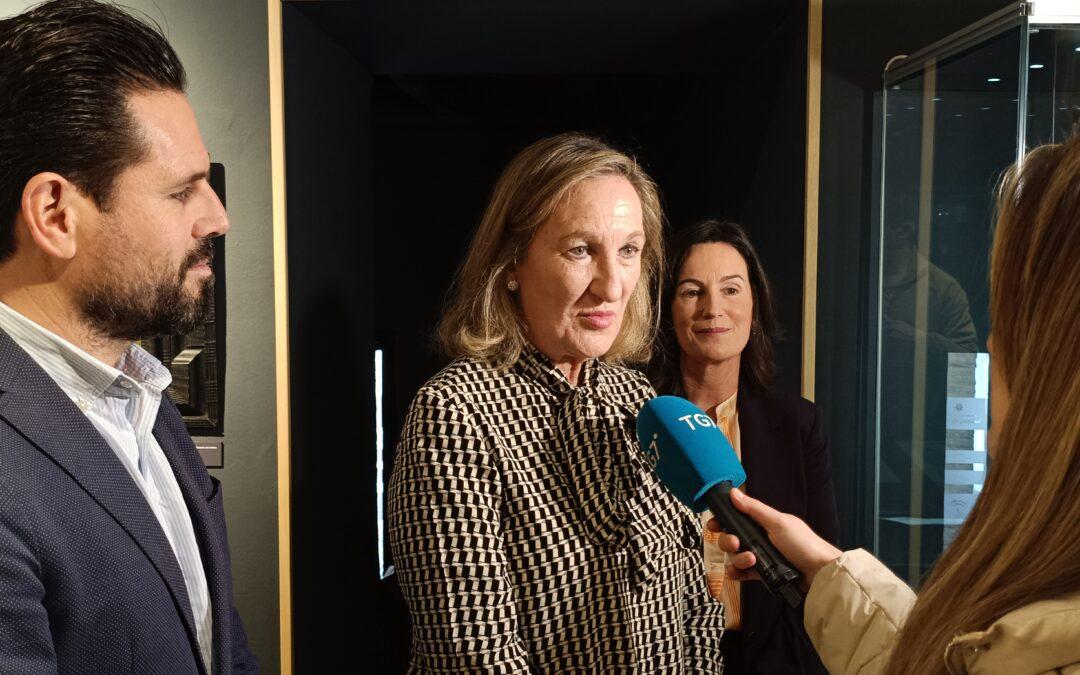
The presentation event featured speeches by Ms. Concha de Santa Ana, Managing Director of the Fundación Pública Andaluza El legado andalusí; Mr. David Sánchez Rodríguez, Territorial Delegate for Culture, Tourism and Sport of the Junta de Andalucía in Granada; and Ms. María del Mar Sánchez Estrella, Secretary General for Historical and Documentary Heritage of the Regional Ministry of Culture and Sport. The event was also attended by Mr. Fernando Egea, along with institutional representatives, specialists and members of the public.
In their speeches, the institutional representatives emphasized the exhibition’s cultural and educational significance, noting how it sheds light on the ways the image of the Alhambra and its surrounding vegetation has evolved over the centuries through a variety of representational approaches.
From the very origins of graphic depictions of Granada, the vegetal landscape has been intimately linked to the Alhambra. As early as the 16th century, the first prints disseminated about the city already incorporated this element, establishing an iconographic tradition that developed alongside the spread of the artistic values of Nasrid architecture.
For a long time, however, printed images lacked one of the key elements that lend credibility to any representation: colour. While painting made use of it from the outset, engraving and other printed media—capable of reproducing and disseminating images on a large scale—took centuries to develop techniques that allowed for its reproduction.
Throughout the 19th century, techniques such as lithography and photography began to experiment with increasingly sophisticated methods to simulate colour, including chromolithographs and photochroms. However, it was not until the 20th century that this process reached its culmination with the definitive incorporation of colour into photography and the publishing industry.
The exhibition brings together engravings, lithographs, chromolithographs, early photographs, paintings and photographic equipment that illustrate some of the techniques, devices and visual strategies used to introduce colour into landscape representation. The works come from a variety of collections and institutions.
French and Spanish institutions have collaborated in the organization of the exhibition, including the Musée Albert-Kahn, the Bibliothèque historique de la Ville de Paris, the Biblioteca de Andalucía, the Real Academia de Bellas Artes de Granada, and the Fundación Pública Andaluza Rodríguez-Acosta, as well as private collectors.
The exhibition is also conceived as an extension of “Gardens of the Generalife and the Alhambra. The Miracle Born from Water”, currently on display at the Palace of Charles V and co-organized with the Patronato de la Alhambra y Generalife.
Dates and opening hours:
The exhibition can be visited at the Corral del Carbón from 13 March to 8 June 2026, from 9:00 to 15:00.
Further information: