


In April 1914, a Swiss painter arrives in Tunisia. It seems to have been guided by the Romantic cliché: the journey to North of Africa, to the exotic and mysterious −at least for the Western consciousness− and to the luminous unknown that was so fashionable at the beginning of the twentieth century. European artists reproduced a folkloric image, the product of a ‘facile Orientalism’ that had emerged from French Romanticism, particularly in the aftermath of the colonisation of Argelia. The paintings repeat motifs and themes, as if they were intended to illustrate passages from the One Thousand and One Nights: women draped in brightly colourful fabrics, Bedouins riding their camels, harem scenes… images of an unfamiliar and incomprehensible world, yet one that proved successful in the art market.
However, despite it may appear to be a recurring trend, Klee’s painting goes beyond this, as the results of the journey −watercolours, drawings and writings− ultimately transcend it.
Paul Klee (1879-1940), the son of a music professor, received a classical education in Bern (Switzerland) and enrolled at the Academy in Munich, where he became acquainted with the theories of the Jugendstil, which he later put into practice. He returned to Bern and devoted himself to music, reading the classics and studying the works of Blake, Klimt, Goya and, in Paris, those of Leonardo and Rembrandt. He subsequently produced a series of drawings inspired by Van Gogh, Cézanne, Matisse and other painters of the French School. In 1911 he came into contact with the group Der Blaue Reiter (The Blue Rider), which enabled him to meet V. Kandinsky and E. Marc, as well as Kubin and Macke. In Paris he encountered Delaunay and the Cubist milieu, and definitively focused his interest on movement and time, light and colour, giving precedence to these over the psychological qualities of forms. The journey he undertook to Tunisia in the spring of 1914, often regarded as pivotal moment in the history of painting, provided him with answers to fundamental questions.
A Fruitful Journey
Our artists arrived in Tunisia accompanied by two fellow painters, August Macke and Louis Moilliet, believing that the travelling together would prove more fruitful than travelling alone. Klee is the only member of the group to record his experience in a travel diary, which reveals that the thirteen-day stay −short but intense− brought about a profound change in his view of artistic concerns.
. Klee financed his journey by selling a large number of paintings to a pharmacist in Bern. After receiving payment, he travelled with Moillet to Marseille to meet up with Macke. In Tunis, they were welcomed by Dr. Jäggi, a friend of Moiliiet, whom Klee described in his diary as comically sober and dry, and they stayed at his house. After three days in Tunis, the three painters visited Dr. Jäggi estate in SaintGermain, from where they travelled by car to Sidi Bou Said and Carthage. From there, they took the train to Hammamet and then on to Kairouan. Unwilling to continue the journey, Klee returned earlier than planned. His two friends remained in Tunisia for more few days.
Personality
Klee’s singular and unclassifiable personality had already set him apart from the two dominant currents of his time: representational formalism and abstraction. According to Klee “art does not reproduce the visible; it makes visible, and the more frightening the world becomes, the more abstract art seeks to be, whereas a happy world produces an art inclined towards the world below”. Klee is one of those rare painters whose intellectual ideas coincide with their artistic intentions. If what he seeks is an exact correspondence between matter and dream, reality and fantasy, he conceives this relationship in its fullest sense: the discovery of a cosmos charged with signs whose meaning has yet to be understood.
What will constitute the object of his enquiry throughout his career is precisely the discovery and preservation of the image in its purest form. He undertakes a cautious and delicate process of substitution, offering the image, made of a purely mental substance, a material form into which it can be transferred and made tangible, almost as if by a miracle.
The question of light in painting had already occupied Klee before he undertook his journey to Tunisia. In 1913, he translated Robert Delaumey’s article ‘On Light’ for the Berlin-based journal Der Sturm. The idea that Delauney developed in this article would subsequently be absorbed by Klee, until ultimately made them his own.
The passage from Delauney’s article that appears to bear direct relation to a work by Klee from 1914, ‘Hillside’ reads as follows: If art does not free itself from the object, it will remain descriptions, literature, continually reducing itself to the slavery of imitation. This also applies when the luminosity of an object is emphasised, or when the relationship between the differing luminosity of several objects is highlighted, without the light itself being represented as such.
Classical art historiography identifies Klee’s full reintegration of colour and light into his artistic practice with his journey to Tunisia. Fragments from his diary shed light on this process:
Tuesdsay, 7 April. In the afternoon, the African coast comes into view. Later, the Arab town emerges clearly. Sidi Bou Said, a hill on which white houses rise in a rigorous rhythm. A fairy tale come true, except that it was still beyond reach, a little way off, yet nevertheless very clear… The sun expresses a sombre force. The luminous brightness of the mainland is promising.
Wednesday, 8 April. Tunis. My head is still filled with the impressions of the previous evening: Art-nature-I. I immediately set to work and painted watercolours in the Arab quarter. I launched an attack in an attempt to achieve a synthesis of urban architecture and pictorial architecture. It is not yet pure, but it is appealing; it contains a good deal of travel humour and enthusiasm, precisely the I. Later, I shall become objective, once the beautiful smog has dissipated.
Saturday, 11 April. Some watercolours on the beach and from the balcony. The watercolour of the beach is still somewhat European. It could just as easily have been painted in the vicinity of Marseille. But with the next one, I succeeded for the first time in expressing what Africa is. The oppressive heat played its part.
Easter Sunday, 12 April. The twilight is indescribable. To cap it all, the full moon begins to appear. Louis urges me to paint it. I tell him it will be no more than a sketch. And, naturally, I failed in the face of this nature. But do I know a little more than I did before. I know the difference between my means and his nature. It is an inner matter for the years to come. I do not feel depressed by this. There is no hurry when one desires something so deeply. This twilight will remain within me, deeply and permanently. When the bright northern moon rises, it will remind me of this night as a fading reflection and serve as a warning to me again and again. It will be like my beloved, like my other self. An incentive to find myself. I myself, on the other hand, am rising of the southern moon.
Thursday, 16 de April. I painted very early on the outskirts of the city, in a slightly diffused soft and clear light. There was no mist. Then I drew indoors…
I am leaving work now. I feel so deeply and peacefully at one with my surroundings that I find it secure, effortless. I feel possessed by colour. I do not need to seek it outside myself; it has me forever, I know that well. And this is the meaning of the happy hour: colour and I are one. I am a painter.
In Saint-Germain, on the outskirts of Tunis, Klee paints several watercolours depicting beaches, gardens and urban subjects. To achieve the desired effects of light, he makes use of the transparency of watercolours and the properties of the paper. The structure of the image is articulated through occasional arrangements of planes of colour, representing the landscape through the presence of depth. The watercolours are suffused with light and light. The luminosity of North Africa, to which he refers in his notes, affects the clarity of the forms as well as the colouring of the surfaces, which become blurred and merge into another, translucent, as colour takes hold of the naturalness of things.
Drawing and Colour
Nevertheless, drawing is not entirely absent, despite the exuberance of the colour. Through the red, yellow and blue layers, a whole graphic activity can be discerned, discreet yet perfectly legible, the recognition of which makes it possible to clarify the genesis of the works, as well as some of the meanings they themselves contain.
A good example of this combination of colour and drawing is the painting Red and Yellow houses in Tunis. The trees, buildings and even the people can be distinguished among overlapping, transparent and luminous colours.
The artistic production he created in Tunisia marks a definitive shift that had already been anticipated in previous years: representation gives way to evocation. The resemblance to what is perceived, to what is before the eyes, gives way to what is evoked by the imagination and memory. The painting Memory Tapestry is an example of his approach. The watercolour is an interplay of signs, colours and forms, and its structure recalls days lived and landscapes observed. Thanks to its blurred, old-carpet-like Background, the painting gives the impression of a fabric covered in mysterious signs reminiscent of cultures and times long past. The very title of the work asserts its dual nature: an interweaving of the motifs that memory associates and weaves together, and a technical and formal synthesis embodied in the tapestry, in which top and bottom, right and left have disappeared, with the structure of the textile now prevailing rather than that of a painting.
Klee is receptive to these signs of a lost language scattered throughout the Tunisian city: in the tattoos on people’s bodies, in the patterns of the fabrics, and on the walls of the mosques. For this reason, his gaze is neither photographic nor that of a collector; he treats these signs not as things, but as elements of an endless conversation, playing with their syntax to arrive at form.
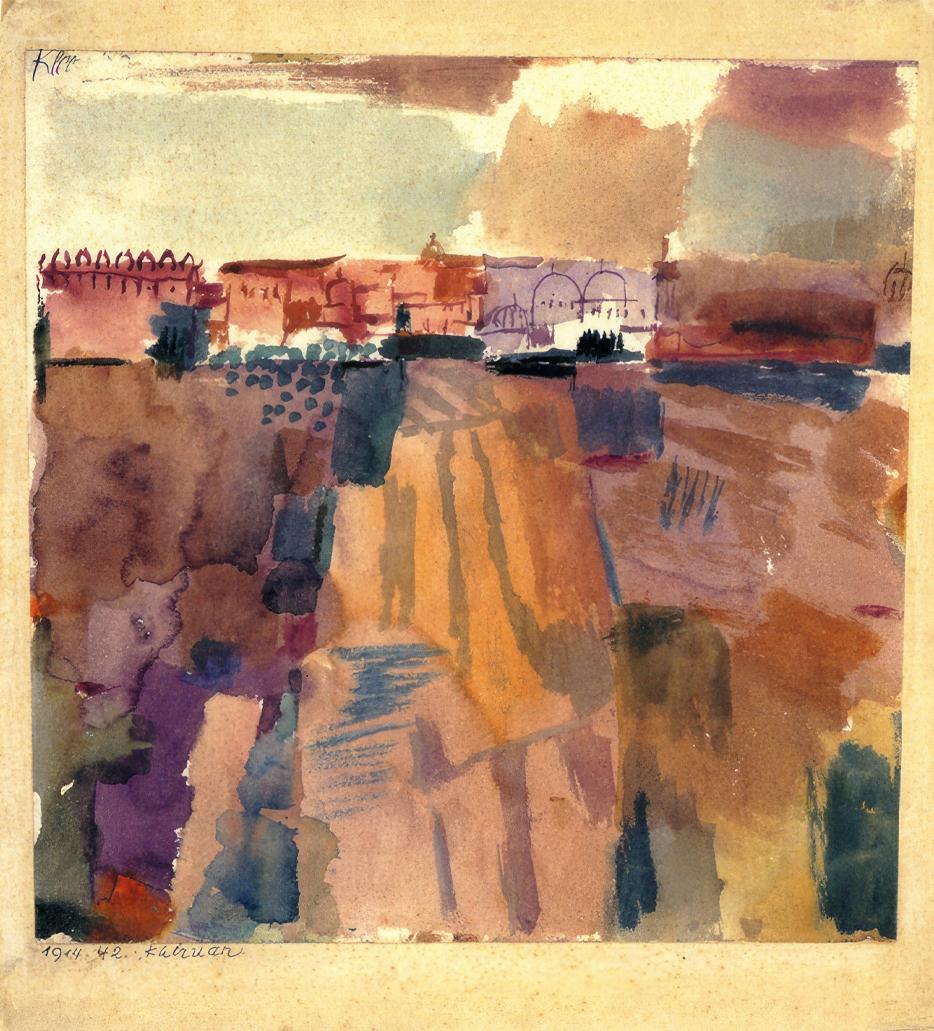
Before the Gates of Kairouan is one of the last paintings he made in Tunisia, painted on the very day he noted in his diary that he had become a painter. The delicate nuances of the overlapping surfaces create a continuity between sky and earth, whose gradual dissolution the viewer can witness by looking closely at the painting.
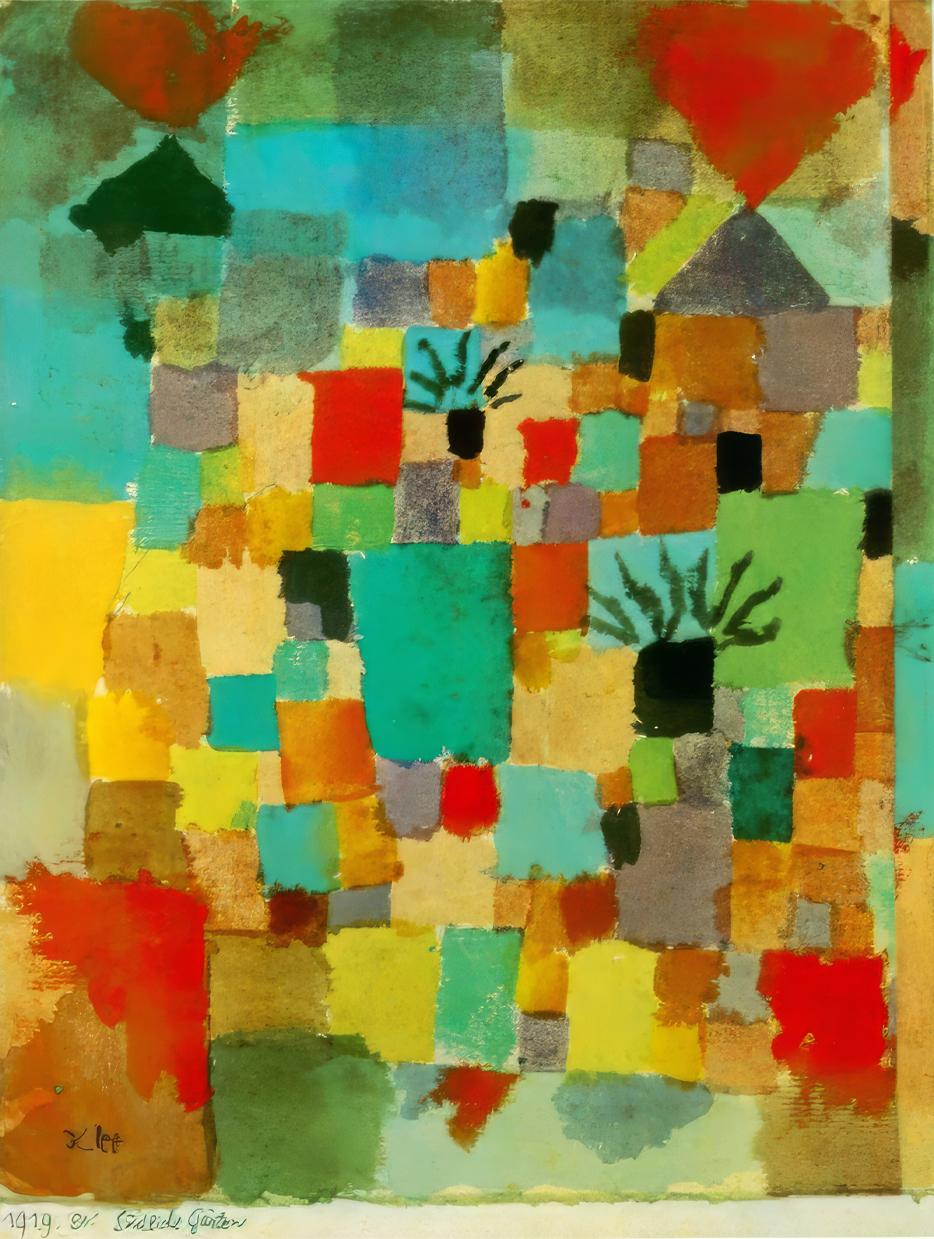
In the abstract watercolours, the luminous tones are always retained, and the transparency of the colour reveals their source: the sensation of the Mediterranean light and sun, the density and the transparency of the air of Tunisia. One of the abstract watercolours, whose title refers to Kairouan, is In the Style of Kairouan, transposed into a more restrained form. The work is composed of unequal rectangles, both large and small, with some circles inscribed within them. The distribution of colours is uneven, with opaque shades of brown, green and red predominating, apart from the three large circles of luminous yellow. The watercolour seems to offer a view of a city from above, as if seen from a bird’s-eye view.
Sunday, 19 April.Departure from Tunis. First, preparation for the journey. Many watercolours and other things besides. Most of it was within me, very deep down, but so full that I manifested itself at every moment… At five in the afternoon, we embarked. Macke and Moilliet are staying on for a few more days. I feel little restless; I am too full; I must work. The great hunt has come to an end. I must work it out.
Klee embarked on 19 April, bound for Naples. On the 22nd he passed through Bern, and by the 25th he was back in Munich. Three months after his return to Europe, Germany declared war on Russia and invaded France. August Macke would die on the battlefield. Klee remained in Munich, painting. What he had brought back from Tunisia would remain present in his work; light and colour would enable him to discover his own distinctive style of painting.
By Vasiliki Kanelliadou. Art historian.

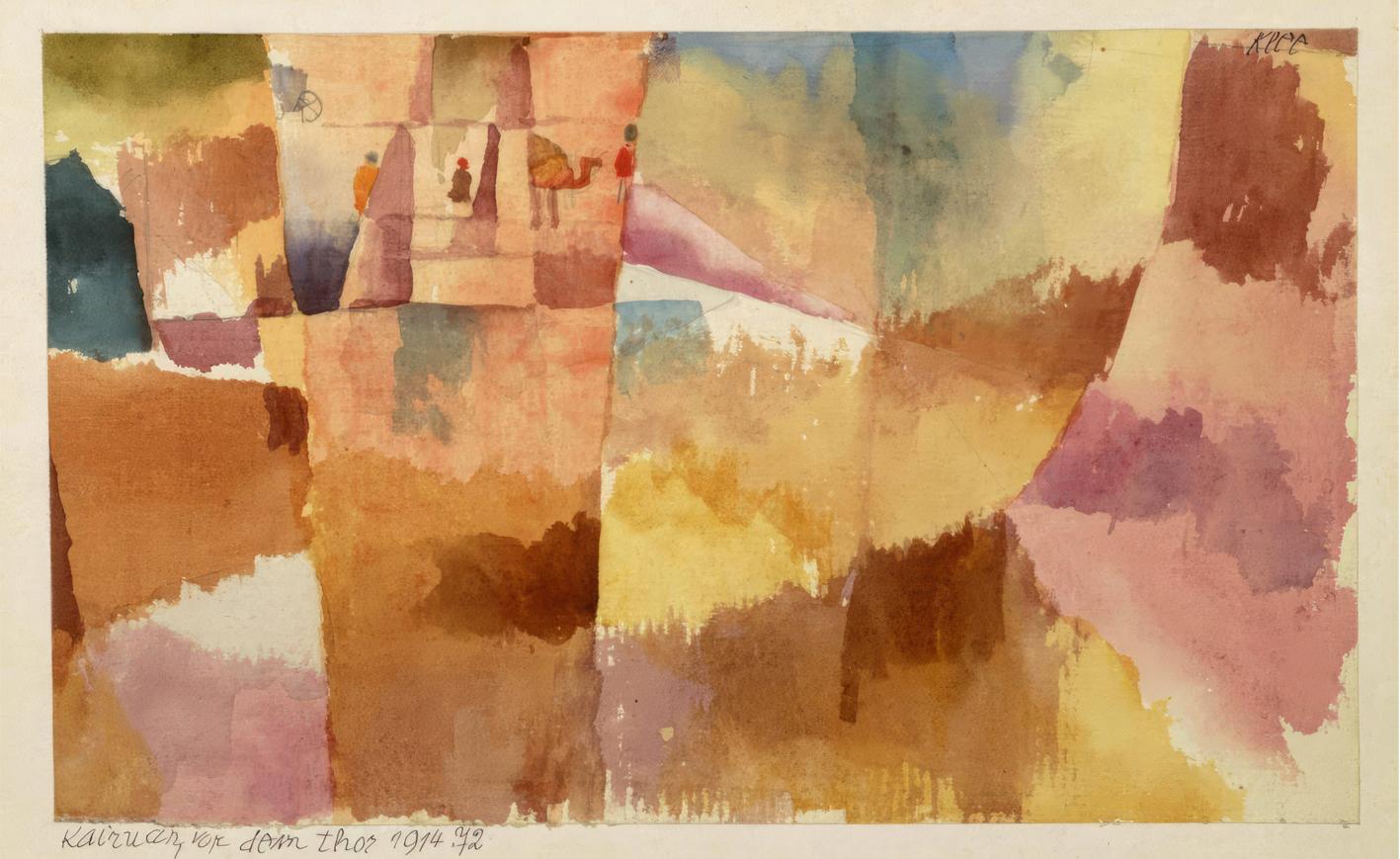
Kairuan,_vor_dem_Thor,_Paul_Klee_(1914)
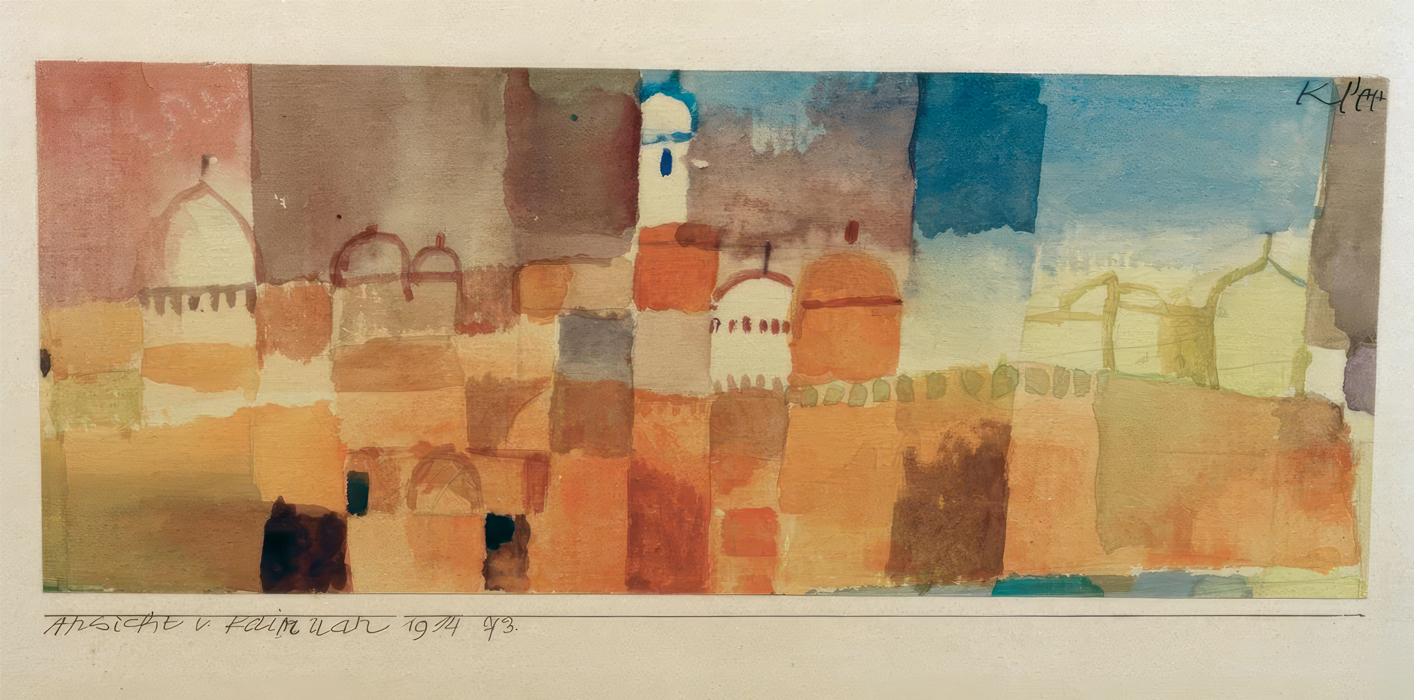
Paul_Klee_-_Ansicht_von_Kairuan_-_(MeisterDrucke-686096)
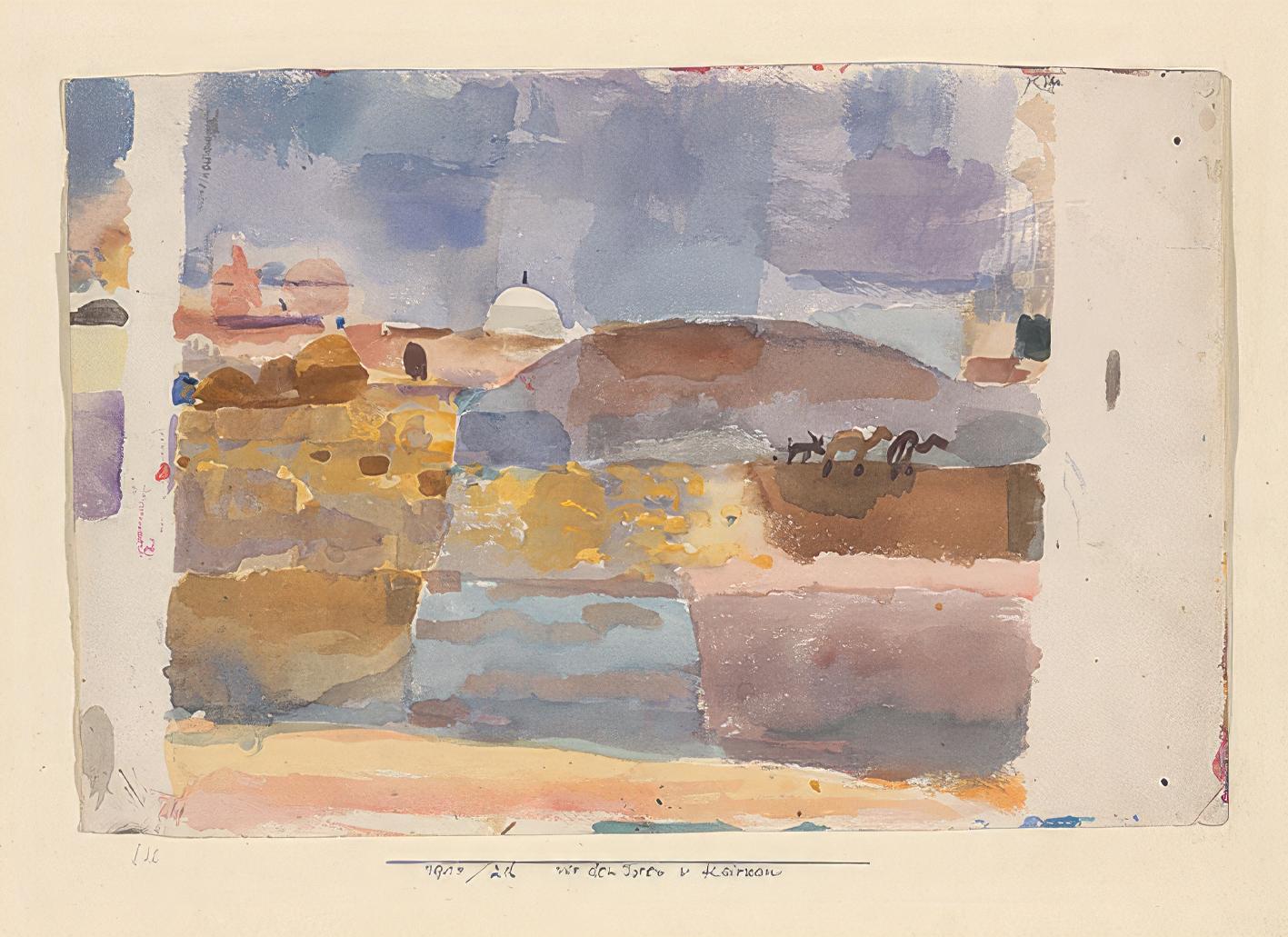
Vor_den_Toren_v
Paul_Klee_Kairuan_1914-42
Southern-Tunisian-Gardens-1919-768×1011