


Mariano Bertuchi remains relatively unknown among the extensive list of great painters from Granada (Gómez-Moreno, Guerrero, Morcillo, López Mezquita, etc.). Perhaps this is because he spent most of his life far from his hometown; however, his name is much more popular among stamp collectors, because many of his works were featured on postage stamps.
Mariano Bertuchi Nieto was born on 6 February 1884 in the Realejo neighbourhood of Granada, specifically at number 2 Calle Escutia.
He soon began to show artistic talent, so his parents took him to the studio of painter Eduardo García Guerra, located on Cuesta del Progreso, and to that of José de Larrocha, one of the most prestigious teachers of the time.
The year 1898 will be decisive in his life as he will travel to Morocco for the first time. The circumstances that led to that journey are almost lost in legend. It is said that Aníbal Rinaldi, interpreter for General O’Donnell and close friend of Mariano Bertuchi’s father, visited his home and saw him painting some Moors in a picture of the Alhambra. He was so impressed that he asked the young artist, ‘What would you like me to give you as a present?’ He replied: ‘Just a Moorish costume!’ Rinaldi, seeing his enthusiasm, invited him to visit those lands with him and choose the Arab costume he liked best. And so, his dream came true when he set foot in Tangier on 31 December 1898.
Bertuchi continued his academic training by enrolling in 1899 at the Special School of Painting in Madrid, where he studied under Antonio Muñoz Degrain and had as a classmate another future famous painter, his fellow countryman José María López Mezquita.During the holidays of that academic year, he will make his second trip to Morocco.
Little by little, the fame of the painter from Granada grew. An important factor in consolidating his prestige was his admission in 1922 to San Fernando Academy of Fine Arts, thanks to the support of the Count of Romanones, the sculptor Mariano Benlliure and the painter José Moreno Carbonero.
During those years, the Rif War was at its height, and many journalists, photographers, and painters accompanied the expeditionary forces in order to report on the tragedy. One of them was Bertuchi, who was already well known as an illustrator for diverse publications.
In the Spanish Protectorate in Morocco, magazines and publications of the colonial troops such as África, Mauritania, Marruecos Gráfico, Almotamid, Ketama and Marruecos Turístico reproduced works by the Granada-born painter on their covers. This latter facet of Bertuchi’s work was evident in the large number of posters he produced on commission for the various official bodies responsible for promoting tourism in the Protectorate: The Royal Tourism Commission, the National Tourism Board and the Official Tourism Committee. In January 1928, he was appointed chief inspector of the Protectorate’s Fine Arts and Indigenous Crafts Services.
Tireless in his quest to revive Moroccan craftsmanship and folklore, seeing how this heritage was being lost, Bertuchi brought together the old masters to teach the new generations. In this way, he began to combine painting and teaching with the management of various institutions, many of which were created and promoted on his initiative: the School of Indigenous Arts in Tetouan, the School of Tagsut, the School of Carpets in Xauen, The Preparatory School of Fine Arts in Tetouan and the Moroccan Museum of the City.
Mariano Bertuchi died in Tetouan on 20 June 1955. Amidst widespread public and official mourning, the painter was buried in the Catholic cemetery in the Moroccan city. Shortly afterwards, his remains were transferred to the cemetery in Málaga until finally resting in that of San Roque (Cádiz).
As expected, the city of Granada also paid tribute to one of its most illustrious sons. The most important events held were an exhibition of his work at the Corral del Carbón. Among and the unveiling of a plaque on 24 June 1956 on the façade of his birthplace. The plaque, consisting of a bronze medallion and a grey marble slab from Loja, bore the following inscription:
The illustrious painter Mariano Bertuchi Nieto was born in this house on 6 February 1884. The City Council of Granada and the School of Arts and Crafts pay tribute to his memory. Year 1956.
The mark he left after his death was so profound that the then King of Morocco, Mohammed V, decided that the educational centers established on his initiative should continue their work after the country gained independence.
Throughout his prolific career, Mariano Bertuchi earned numerous distinctions, among them, to mention the most recent one, was the awarded by the Granada newspaper Ideal after conducting a survey among its readers in the late 1990s to choose ‘The 100 most famous people from Granada in the 20th century.’
The philatelic legacy of Mariano Bertuchi
Through the Spanish-French treaty signed on 27 November 1912, France granted Spain the administration of various territories located in northern and southern Morocco, establishing the Spanish Protectorate in the Rif and Tarfaya, with its capital in Tetouan.
In 1914, Spanish postal services were transferred to the Protectorate, with the exception of the Tangier Office. Thus, the stamps used by the Khaliphate postal service were Spanish stamps with different surcharges for postal use in the area (Morocco, Spanish Protectorate of Morocco, Spanish Protectorate Zone in Morocco and Spanish Protectorate Zone). The French authorities would use this same technique until 1917, when they issued their first series, beautifully crafted, reproducing monuments from various cities within their area of influence.
The success of this initiative prompted the Protectorate authorities to request the issuance of their own stamps in order to raise funds for the Khaliphate Treasury (philately was at its peak) and also to promote the tourist attractions of northern Morocco; however, these requests were repeatedly rejected by the Spanish authorities.
It was in this context that Mariano Bertuchi first emerged as a philatelic designer, when in 1922 he submitted a sketch (of the Sidi Saidi Mosque in Tetouan) for a future stamp issue that ultimately did not come to fruition.
After several failed attempts, on 7 September 1928 the first series specific to Spanish Morocco, ‘Landscapes and Monuments’, was released, with Mariano Bertuchi responsible for its design. The issue, which was admired for its beauty, was printed in intaglio by the London firm Thomas de la Rue and consisted of fourteen stamps reproducing six works by the painter: Al Hoceima, the Mosque of Sidi Yacoub in Alcazarquivir, the Gate of Larache, Tetouan, Chefchaouen and, to top it all off, a scene of a horseman on horseback for the express mail stamp.
Another renowned English company, Waterlow & Sons, was commissioned to produce the following issues: ‘Views and Landscapes’, in 1933–1935 and 1935–1937; in 1937, two sheets with the slogan ‘Viva España!!’ (‘Long live Spain!’), containing the stamps from 1935-1937, and ‘National Uprising’, with portraits of the various groups involved in the military uprising of 1936 (legionnaires, militias, regulars, etc.); in 1938, ‘Landscapes’ and in 1939 ‘Various Types’.
One of the Protectorate’s most unique series was ‘Pro Tuberculosos.’ It debuted in 1946 and appeared every year until 1954. Its motifs alternated between views of hospitals and tuberculosis sanatoriums alongside allegories, arabesques and landscapes. All the stamps bore the emblem of the Moroccan Anti-Tuberculosis Board: two crescent moons joined by a vertical line.
Another characteristic issue was ‘Various Types’, a colorful mosaic featuring cityscapes alongside landscapes and military scenes. It was issued during 1939, 1940 and 1941. Within this group we can also include the 1952 series, ‘Indigenous Types’, although in the latter the folkloric aspect predominated over the landscape, with traditional festivals such as Pascua Grande and typical ceremonies such as the Ofrenda or the Romería[1]..
We should also mention the programmes devoted to trades and various economic activities. The ‘Agriculture’ series was the first to appear, in 1944, with scenes depicting various tasks such as sowing, reaping, threshing and the harvesting of oranges. In 1946, ‘Craftsmanship’, followed, with images of potters, dyers, slipper makers and carpet weavers. In 1948, the series entitled ‘Commerce’ was released, and finally, in 1950, ‘Hunting and Fishing’, with motifs alluding to tawny owls and hunting.
In addition to series intended for airmail in 1942, 1949 and 1953 (‘Landscapes and Aeroplan’) and a basic series called ‘Figures’ (1953), some series were also issued that could be considered commemorative in addition to those already mentioned, such as those for the 75th anniversary of the UPU and the one dedicated to the Khaliph’s wedding, both in 1949; the one that appeared in 1952, called ‘Pro-Museo Postal’; in 1953, the one referring to the 25th Anniversary of the First Moroccan Stamp, also with scenes of local customs; and finally, in 1955, the one called ‘Typical Gates of Tetouan’, which reproduced the Gates of the Queen, Saida, Ceuta and Tangier.
The last series of the Spanish Protectorate was broadcasted on 8 November 1955 to celebrate the 30th Anniversary of the Enthronement of His Highness the Khaliph. This commemorative issue was unique in many ways, as it marked the end of postal issues in this territory (Morocco would proclaim its independence the following year) and was the last designed by Mariano Bertuchi, posthumously, as the painter had died a few months earlier. Another noteworthy circumstance is that it was the only one produced by the National Mint and Stamp Factory, the official printer of Spanish stamps and banknotes, thus breaking the monopoly held by Rieusset S.A., Heralmi, of Barcelona, for the production of stamps for the Protectorate since the 1941 ‘Various Types’ series.
Bertuchi’s work was not only reflected in the stamps of the Protectorate: Cabo Juby, Ifni, Spanish Sahara and even Spain adopted his designs. The fame that was beginning to distinguish the artist from Granada as a postage stamp designer led the Post Office of the Second Republic to take notice of him for the 1936 issue commemorating the 40th anniversary of the Press Association. The series, printed by Waterlow & Sons, reproduced works by Cano, Sánchez-Toda and Bertuchi, who drew the Palacio de la Prensa (The Press Palace), Clavileño[2], the Nazaret School and the value of express mail, a newspaper delivery boy.
In 1943, he collaborated with the Directorate-General for Morocco and the Colonies, under the Presidency of the Government, designing the series Ifni (‘Various Types’ and ‘Landscapes and Aeroplane’) and Spanish Sahara (‘Indigenous, Fauna and Flora’ and ‘Aeroplane in Flight’). In 1947, he also produced the programme ‘Familia Nómada’ (‘Nomadic Family’) for Ifni.
As for Cabo Juby, it used exclusively stamps from Spanish Morocco bearing the inscription Cabo Juby. Specifically, these were the issues of 1928 (‘Landscapes and Monuments’); 1933–1935 (‘Views and Landscapes’); 1937 (‘National Uprising’); 1938 (‘Landscapes’); 1939 and 1940 (‘Various Types’); 1942 (‘Landscapes and Aeroplane in Flight’); 1944 (‘Agriculture’); 1946 (‘Crafts’); and 1948 (‘Trade’). It should be noted that the stamps in some of these series had slight differences in colour tone compared to similar stamps issued by Spanish Morocco, in order to make them more difficult to counterfeit.
In addition to stamps, Bertuchi designed other philatelic items. Among these, the set of postcards ‘todo postal’[3] that he designed deserves special mention. They are little known but highly prized for their beauty, rarity and value. The first ones began to be issued in 1933 (‘Landscapes’) and reproduced the stamp dedicated to the Zauia of the Harrak Mosque and the Gate of Ceuta from the ‘Views and Landscapes’ series of 1933-1935. Subsequently, the following appeared: in 1935, ‘Ketama Forest’, which reproduced the same effect as the ‘Views and Landscapes’ series from 1935-1937; in 1939, ‘Ketama Forest’ again, with a 20-cent denomination, and ‘Views of Tetouan’, with the stamp from the 1939 series ’Diverse Types’ (Sidi Ben Nazar Street in Tetuán); and, finally, the extensive ‘The Walls of Tetouan’ issued throughout the period 1944-1956.
Perhaps it is here where we can best appreciate the beauty of his pictorial work, because in addition to the stamp motif (the walls of Tetouan), on the left side of each card there was a reproduction of a typical Tetouan scene drawn in pen and ink by the artist. In total there were 72 cards with six different scenes, a whole catalogue of Moroccan customs masterfully captured by what was once its finest painter.
It should be noted that Cabo Juby also used several postcards from Spanish Morocco, adapting them for use in this small enclave in southern Morocco: in 1934 (two stamps from the 1933 ‘Landscapes’ series) and in 1935 ‘Ketama Forest’.
Bertuchi also designed the stamps issued by Telégrafos in 1936, which were simply a reissue with new values of the 1928 series, ‘Landscapes and Monuments’; the charity stamps, which appeared in 1941, 1943 and 1945, all for War Disabled Persons, with portraits of General Franco; and even the only aerogramme issued by the Protectorate in 1949, which reproduced the stamp entitled ‘Horseman’, part of the ‘Landscapes and Aeroplane’ series from the same year.
He also left his mark in the field of fiscal philately. The first copies to feature designs by the Granada-born painter were printed in intaglio by Thomas de la Rue with arabesques and sgraffito motifs, all of great artistic beauty. Subsequently, new series appeared, this time printed by Rieusset and the Burgos-based firm Hija de Braulio Fournier, with allegorical motifs representing ‘Commerce and Industry’.
Charity cartoons were also used in the Protectorate, some of which were drawn by him. We can mention those issued for the benefit of the Association of Army Widows and Orphans, with scenes of war, those dedicated to the Moroccan Railway Staff Mutual Aid Society, and those intended for the Charitable Association of Civil Servants in the Area.
The importance of Mariano Bertuchi as a stamp designer was finally recognised in March 2019, when the Spanish postal service dedicated a stamp to him.
The broadcast, which was highly original, simulated the fold-out designs of old postcards. The front featured a photograph of the painter in his Tetouan studio next to his easel and reproduced one of the stamps from the 1928 issue ‘Moroccan horseman’, the first designed by the painter. They also depicted the oil paintings from the triptych commissioned by the African Casino in Ceuta in 1921 ‘Commerce, Agriculture and Industry’. On the reverse side, there was another stamp from the 1928 series, ‘The citadel of Larache’ and on the following pages, different models of the entero postales he designed for the Protectorate.
Mariano Bertuchi’s philatelic legacy was spectacular. There are very few comparable examples in world philately, except for a few French engravers such as Gandon and Decaris, or the Swedish artist Czeslaw Slania, who designed even more stamps during their respective careers (which were considerably longer, incidentally). However, there has never been a case of the same artist designing all the stamps for a postal administration (the Spanish Protectorate in Morocco) over such a long period, from 1928 to 1955. That honour belongs to the painter from Granada.
A quick look at the EDIFIL catalogue confirms this: a simple count shows that his brushes produced 224 works that were reproduced on 580 postage stamps, not to mention other philatelic items such as charity stamps, telegraph stamps, revenue stamps and ‘entero postales’.
Without a doubt, we can consider Mariano Bertuchi to be the stamp painter par excellence.
Luis Morillo Vílchez
Granada Philatelic and Numismatic Society
[1] Traditional festival with snacks, dancing, etc., held in the countryside near a chapel or shrine on the local religious holiday.
[2] Clavileño is a wooden horse that appears in Don Quixote, that recounts the joke that some dukes played on and Sancho.
[3] Postal cards that bear the officially authorized pre-printed stamp.
|
BIBLIOGRAFÍA – Catálogo Unificado de Sellos de España y Dependencias Postales. EDIFIL, S.A. Madrid, 2005. |

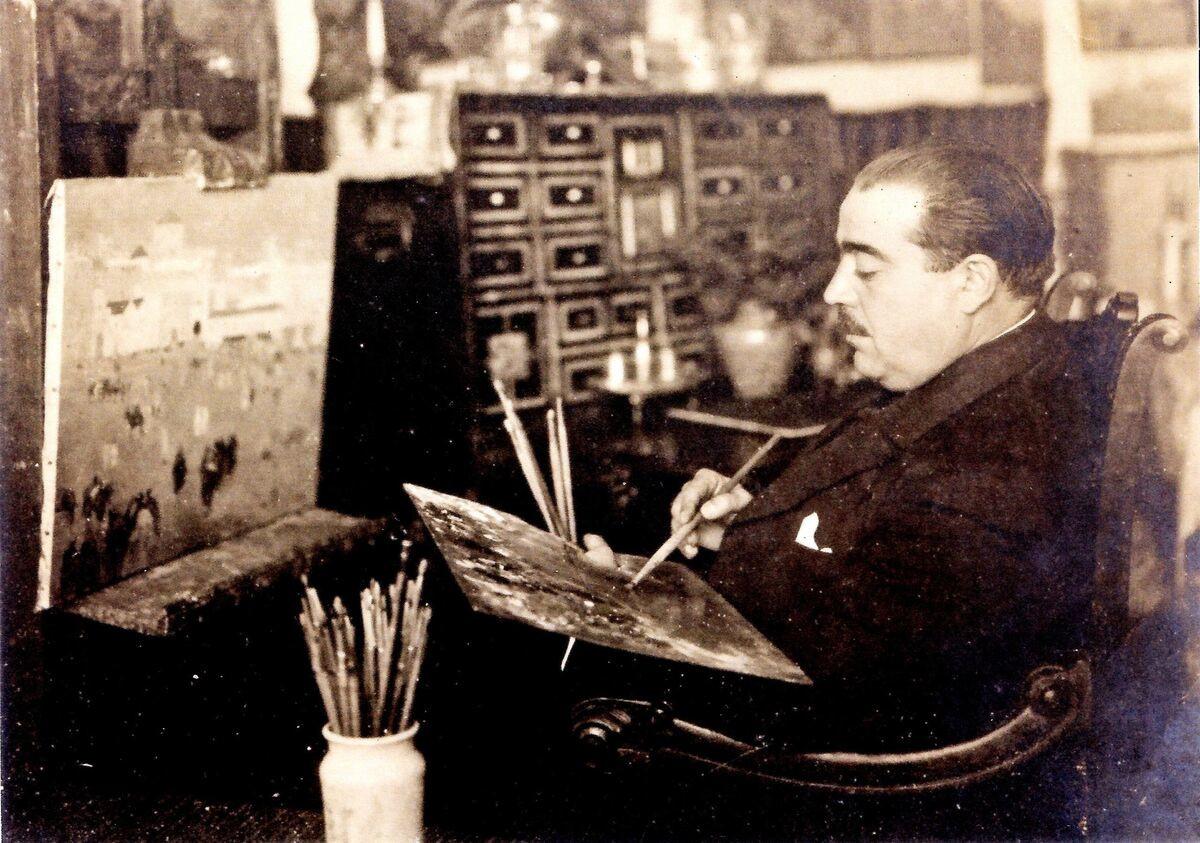
Mariano Bertuchi Nieto in his studio.
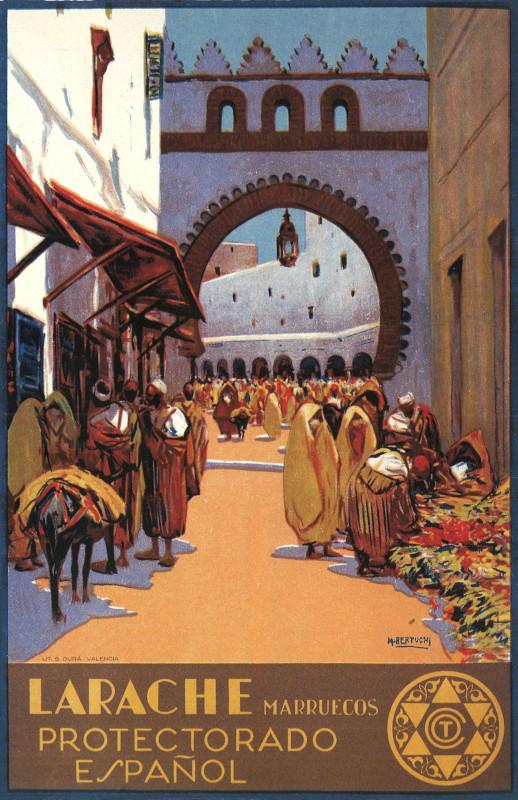
Larache poster.
Mariano Bertuchi was an accomplished poster artist who contributed more than anyone else to promoting the tourist attractions of the Spanish Protectorate of Morocco.
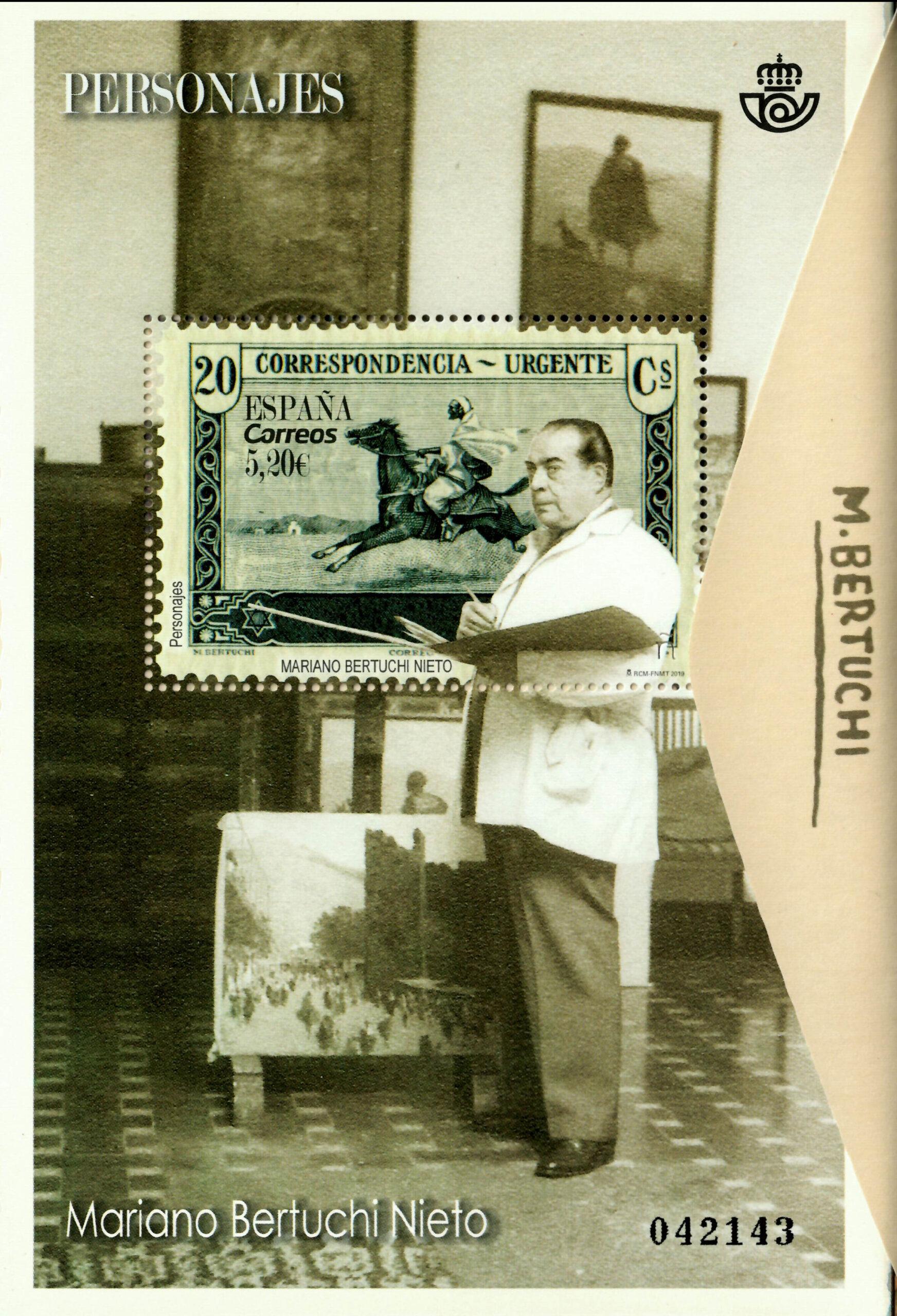
Bertuchi stamp cover.
In 2019, Correos paid tribute to Mariano Bertuchi by issuing a stamp featuring a photomontage of one of the stamps from the first series (‘Landscapes and Monuments’), which the painter designed for the Protectorate.
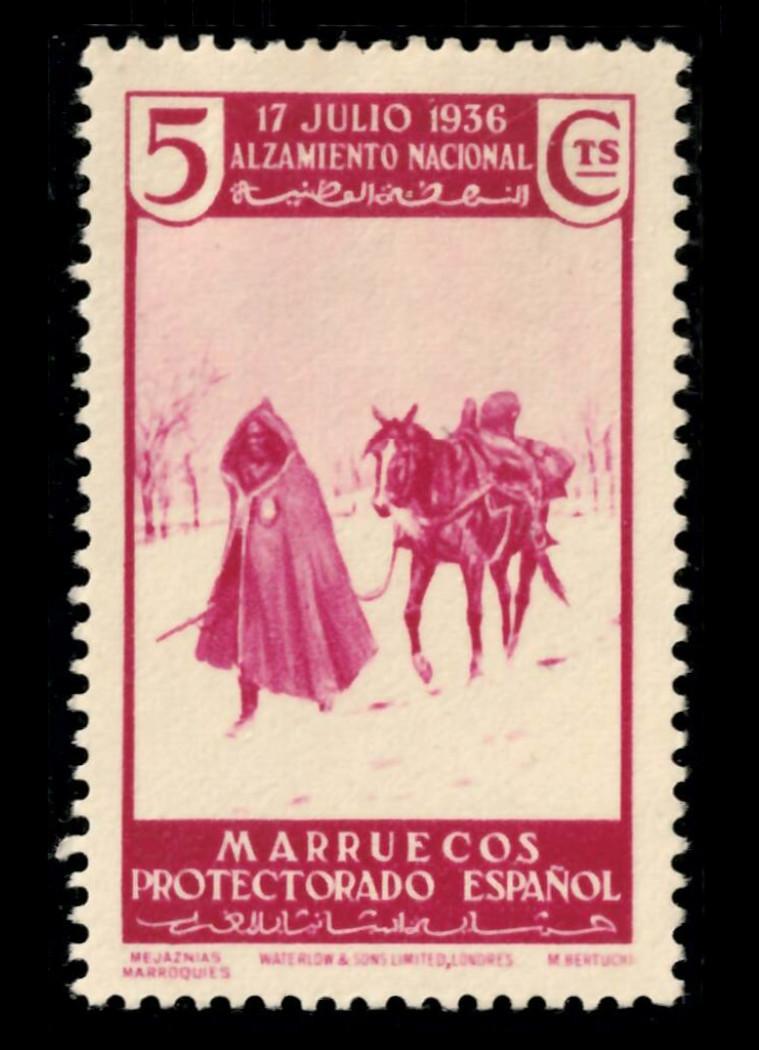
Commemorative series ‘National Uprising’.
Waterlow & Sons printed several series for the Spanish Protectorate, such as this one from 1937 commemorating the ‘National Uprising’. The 5 cents stamp depicts the image of a ‘mezjanía’ walking on snow.
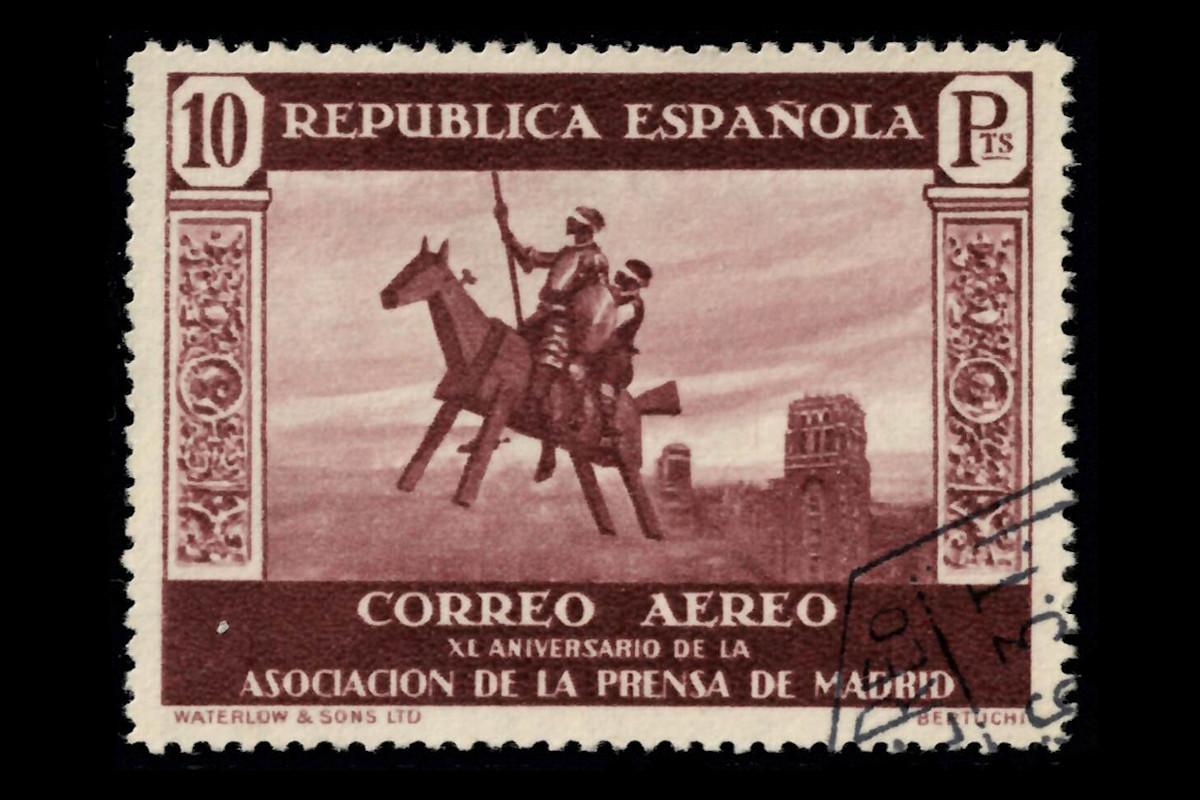
Commemorative stamp marking the 40th Anniversary of the Press Association.
In 1936, the Second Republic’s postal service commissioned Mariano Bertuchi to create several designs for an extensive series commemorating the 40th anniversary of the Press Association. One of these was this design featuring Clavileño.
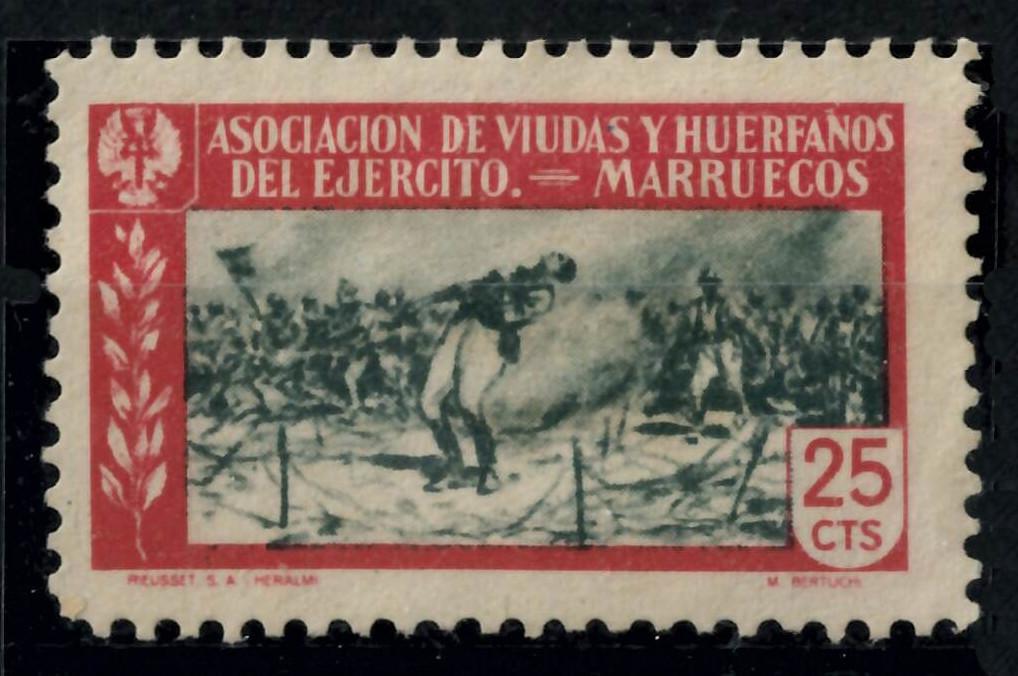
Charity stamp for the Association of Army Widows and Orphans.
The stamps created by the artist from Granada were also used for charity purposes by various associations, such as this example intended for the Association of Army Widows and Orphans.
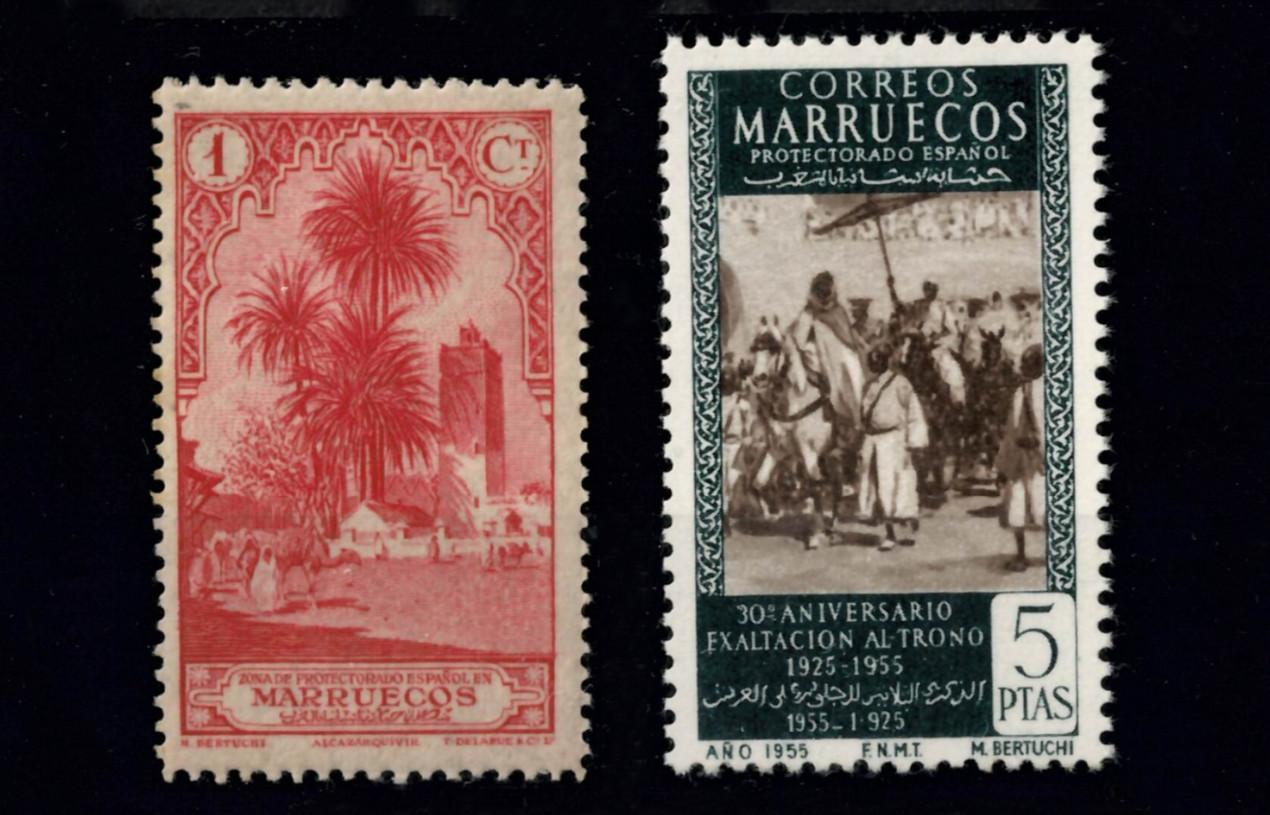
Commemorative stamps marking the Accession to the Throne, 1925–1955.
Stamps from the first and last (posthumous) series designed by Bertuchi for the Spanish Protectorate of Morocco. From 1928 to 1955, the Granada-born artist designed all the stamps issued by this postal administration.
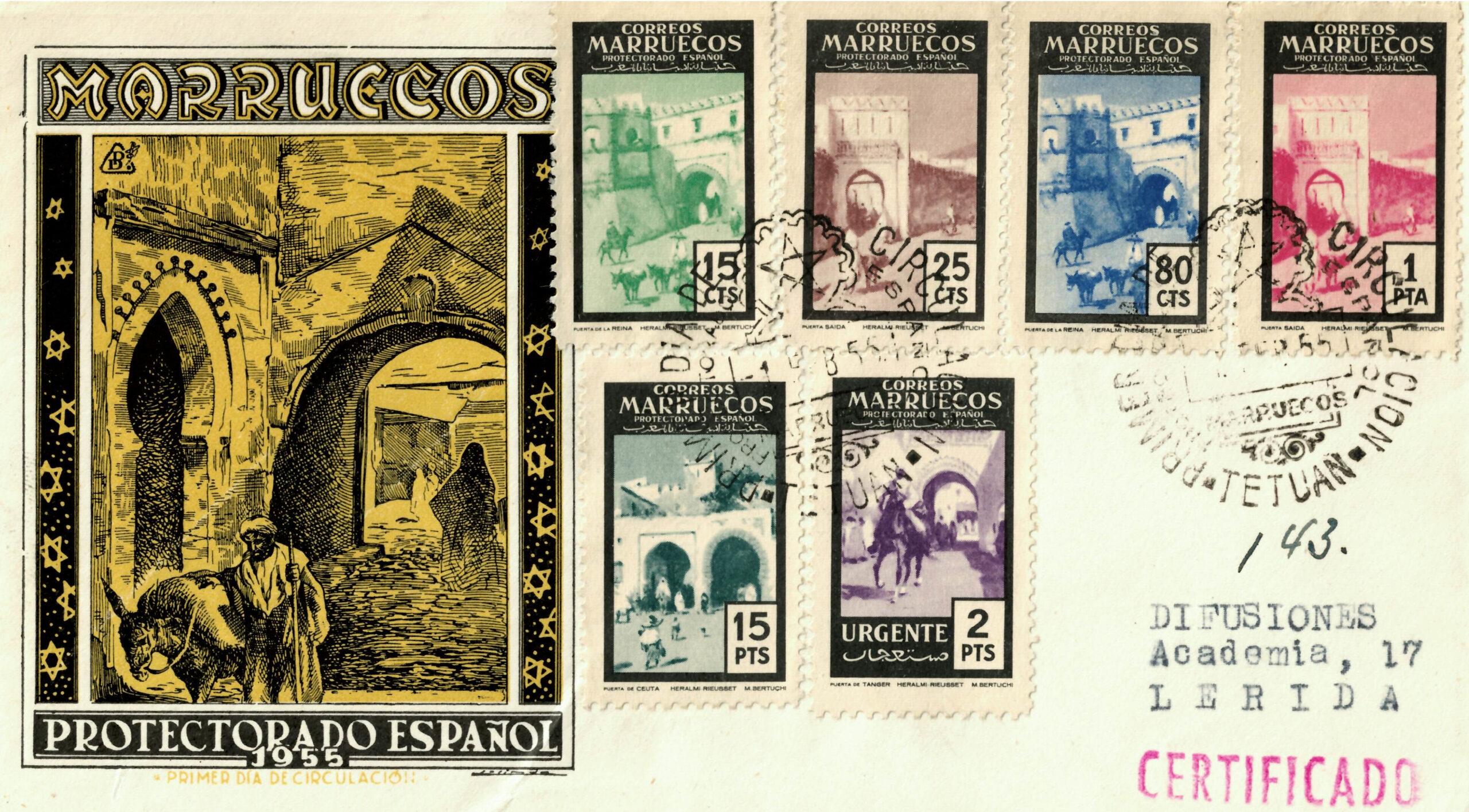
Gates of Tetouan.
About the first day of issue (FDI) of the series ‘Typical Gates of Tetouan’ circulated from Tetouan to Lleida.
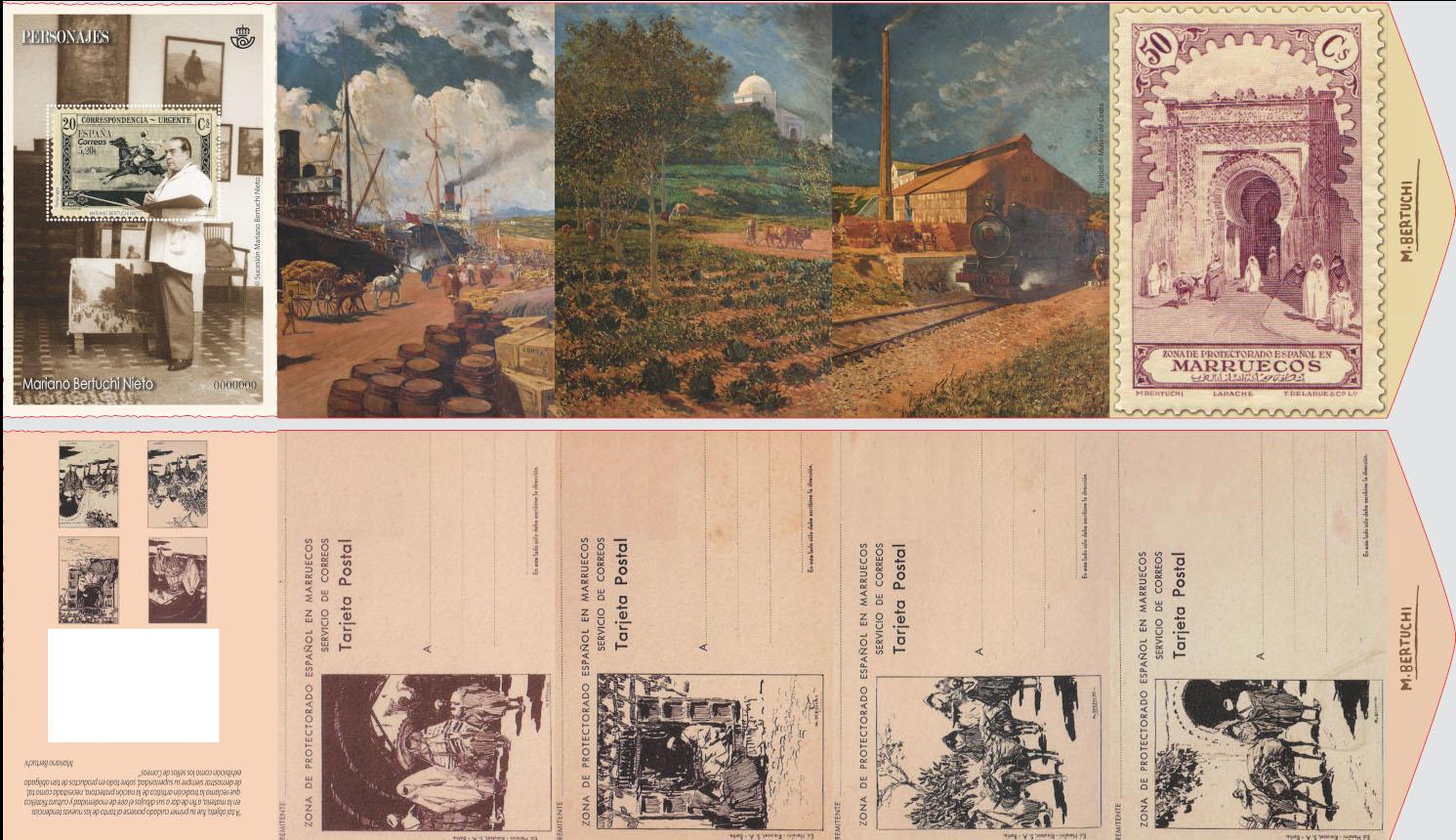
Spanish stamp unfolded.
The aforementioned 2019 issue, when fully unfolded, resembles old postcards.
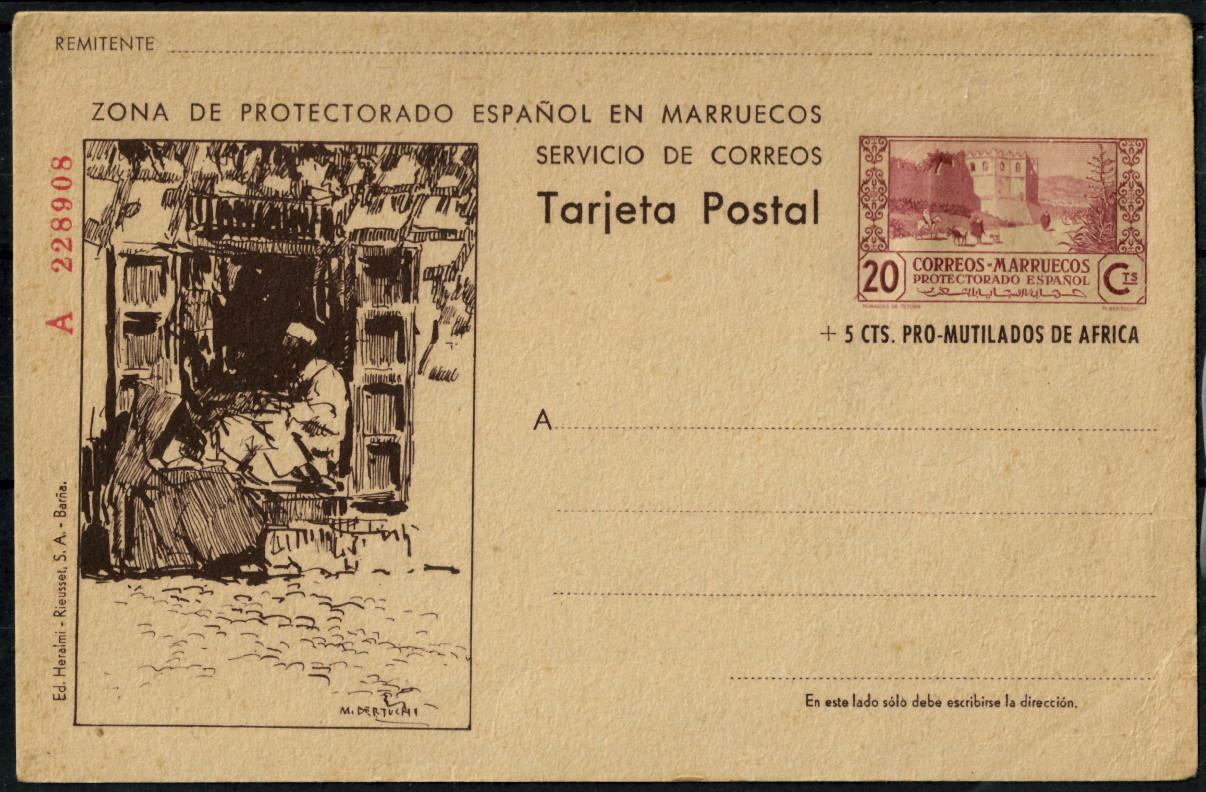
Postal stationery card.
One of the beautiful postal stationery cards that were part of the extensive series ‘Walls of Tetouan’, issued between 1944 and 1956.