


Colonel T.E. Lawrence, in the introduction for the 1921 reprint of Travels in Arabia Deserta, assured the reader that ‘it was not a book like any other, but something quite apart, a kind of Bible’. ‘A classic that is timeless and will never go out of fashion,’ he added. ‘This is the first essential work on the Arabs of the desert we canno do without’. For the author of The Seven Pillars of Wisdom and the instigator of the great Arab revolt led by Sharif Hussein of Mecca, the exceptional nature of Charles Doughty’s book lay in its complete absence of the picturesque, ’that flaw so common in accounts of travels to the East’. ‘The more we learn about Arabia, the more we discover in Arabia Deserta.’
But who was this Charles Doughty, whose personality made so little impression on those who knew him, in stark contrast to his work, which will leave an indelible mark? Born on 19 August 1843 in the county of Suffolk in England, he was the son of the Reverend Charles Montagu Doughty, and according to tradition was destined to become a ‘squarson’, a cross between an Anglican clergyman and a gentleman farmer. Very quickly, however, he was drawn to the marine world, and as he failed to enter the Royal Navy, he had to settle for geology. This led him to study glaciers and several expeditions to the mountains and frozen lakes of Norway. However, his career as a geologist did not last long, because what he was passionate about was literature. He studied English literature in London and Oxford, and then, in keeping with a certain British tradition, set off on what was known as the Grand Tour – a journey through European countries, particularly Greece and Italy, which young people used to undertake before entering working life. But Doughty’s tour would take him to the East.
It is 1870 and Doughty is 27 years old. He begins by visiting Belgium, France and Italy, and from there he sets sail for Tunisia, from where he continues on to Algeria and then Spain, simply because he had not found a way to reach the Iberian Peninsula directly from Italy. He arrived in Greece in June 1873, where he stayed for nine months. Instead of returning to England, in February 1874 he set sail for Palestine, where he visited the holy sites extensively, like a true pilgrim, before travelling on to Cairo. He isn’t particularly taken with the city and makes two trips to Sinai. In May 1873, he crossed Aqaba and ended up in Petra almost by chance, so to speak. On his journey northwards towards Damascus, he stops off at Ma’an, where the Turkish governor tells him about Mada’in Saleh and its inscriptions. Doughty, who until then had travelled on a whim, suddenly found a purpose for his winding journey: he would do everything in his power to explore these ruins, which no European had ever reached before.
Destination Madai’n Saleh
After Edward Said, it was thought possible to argue that Doughty was nothing more than a follower within the literary genre of travel to the East, which throughout the nineteenth century served the imperialist aims of colonial conquest. Had he not followed in the footsteps of his predecessors, continuing their research beyond their intended destination? Exploring the desert regions lying between Damascus and the south of what is now Jordan was the aim of European travellers and the geographical societies that funded them. As early as 1812, the Swiss explorer Johann Burckhardt had ventured into the far south, dressed as a Syrian, and had discovered Petra by chance – the ancient city of the Nabataeans. He pretended to be a scholar of Islam, but the Arabs in the area would not let him enter the ruins. In their wake, many travellers ventured into the nomadic world—without ever really managing to become part of it—sometimes for the sole purpose of buying horses to import them to Europe.
Many others also dreamt of exploring the Arabian Peninsula, following in the footsteps of the German scholar Carsten Nieburg (1733–1815), whose companions all perished from exhaustion or illness in the desert. For his part, Burton undertook the pilgrimage to Mecca whilst posing as a Muslim, and in 1855 he drew on this experience to write an account that does not seem to have impressed Doughty. However, interest in the desert did not emerge until the late 19th century, through a succession of travellers, including the archaeologist Gertrude Bell, who published The Desert and the Sown in 1907, T.E. Lawrence and the famous Wilfred Thesiger, whose feat of crossing the Empty Quarter (al-Rub’ al-Jali) would only be matched by Théodore Monod in the Sahara.
Everything about Charles Doughty’s behaviour was unique. Right from the start, the trip had not been properly planned. Doughty was not wealthy and set out on his adventure without the financial support of the Royal Geographical Society, whose moral backing was just as important, if not more so. He suffered terribly from the lack of support from the British consulate, and subsequently the Turkish authorities refused to grant him safe conduct. Whilst other travellers secured permits, letters of recommendation and a host of gifts – not to mention the necessary equipment and, above all, money – our remarkable traveller set out on an unprecedented venture without any help or financial support.
Furthermore, he intended to follow the Hajj caravan (pilgrimage to Mecca) without his Turkish commander being aware of it, and without concealing the fact that he was a Christian and a stranger. To this end, he joined the group of Persian pilgrims, dressing in the manner of the Christians of Syria – something Burton would later criticise him for.
Damascus
He left Damascus on Thursday 10 November 1876, and his journey ended on 2 August 1878 in Jeddah, where he stayed for two months to recover his health. He travelled to Mada’in Saleh with the Hajj caravan, which now numbers just 6,000 pilgrims, compared with the thirty or forty thousand at the start of the century. In any case, that did not make the journey any safer, and Doughty, who was constantly on his guard, fell victim to all manner of thefts and harassment. In Ma’an, they assure him that his camel has died, and they bring him a young female camel that is struggling to walk. On other occasions, the camel driver doesn’t bring his mount when it’s time to set off. He arrives in Madah Saleh on the fourth Sunday of the journey, which also began on a Sunday. He stays there, whilst the caravan continues its way towards the holy cities. Doughty explores the monuments and transcribes or traces the inscriptions carved in the stone. And when the caravan returned, he had already decided not to join the pilgrims again, because in the meantime he had met some Bedouins who had made him consider the possibility of venturing eastwards into completely unexplored areas.
He leaves the registration formalities to the pasha and embarks on a new odyssey in the company of Sheikh Zayd of the Fejr. He shares the nomadic way of life in the tribe’s camps, until, stage by stage, he reaches Tayma, in Chammar territory. Explore the Harra, a lava plain where you can visit several craters, and then head to Hail, where he manages to secure an audience with the emir. The end of his stay was very eventful: people treated him badly and snatched his luggage from him. On arriving in Unaizah, the rest of his belongings were stolen, leaving him completely destitute, with no support whatsoever and hundreds of kilometres from the nearest coast. Despite everything, he does not lose heart and joins the caravan travelling to Mecca, intending to leave it before entering the sacred precincts, which are off-limits to non-Muslims. His travelling companions, who mistreat him and take away what little he has left are about to kill him. He is ill and in a pitiful state, but his recklessness saves him, and he does not even give in to the pressure to convert to Islam to save his life. Finally, he manages to get himself taken to the Sharif of Mecca, who is currently residing in Taif. And that is where he finds his salvation.
When viewed in its proper context, Doughty’s journey can only be described as exceptional and spellbinding. Here we have a man with no support and no wealth, who sets out, completely unprepared, on a journey to the Nafud, in a part of the Arabian Peninsula that not even a Muslim from the neighbouring countries would dare to set foot in. Even the pilgrimage procession, protected by a substantial security detail and following a marked route, was not entirely safe. And what can one say, then, of the remote desert! And above all about the oases of Hail and Khaybar, where Wahhabism was already firmly established! The most remarkable thing about Doughty’s adventure is the composure with which he always faces all the ups and downs. It is neither arrogance nor contempt. His very astute observations on tribal society do indeed contain a judgement which may seem very harsh and disparaging today, but which remains fair and, above all, moral. Doughty never shows any romantic affection or tender fascination, as today’s travel writing trends would require. ‘Doughty shows us the limitations of such a stance,’ writes François Pouillon in his critical study of the abridged edition published by Payot in 1994. ‘The twists and turns of his adventure do not paint him as a particularly likeable character, and for that reason we feel the story is told with sincerity. An unconventional traveller, who sets out without any particular protection, leaves us astonished by the confidence that drives him; he derives the meaning of his mission and his work from a doctrine that we can safely describe as reactionary. And it is precisely […] imperial arrogance that leads this son of a religious pastor – whose religious convictions are rather lax – to persist in a region where Islam is strictly observed, and to proclaim himself a Christian at the risk of his own life. Last but not least, he is completely devoid of a sense of humour.’
The moral rigour of this intrepid traveller leads him to make nuanced judgements and compels him to recount events and things exactly as he observed them, without attempting to distort or embellish them.
Hence, a tale of remarkable tenacity, which at times takes on the tone of a report by an entomologist, or even a mineralogist – lest we forget, Doughty was trained as a geologist. His descriptions are clearly influenced by this fact, and there is no doubt that he derives from it a mindset that prompts him to understand the entire ecosystem of life in the desert, encompassing both flora and fauna. He spares no detail whatsoever, not even the most trivial, as if his aim were to give a comprehensive account of a way of life in its entirety, without allowing himself to be selective in the information he provides. Nature, animals and people are all subject to the same gaze.
All this makes Doughty’s book even more valuable and compelling; it has not aged in the slightest in just over a century, even though the world it describes had vanished. On the pretext that T.E. Lawrence recommended the book to British military personnel involved in Sharif Hussein’s Arab Revolt, some researchers have recently sought to reduce this work to an exhaustive exploration of a part of the peninsula for political or military purposes. Whether consciously or not, the author would then be taking part in this vast undertaking, which involved gathering information on little-known territories. However, Doughty himself suggested another approach.
Contributing to the advancement of the sciences of antiquity does not seem to have been his primary concern, although it was important. Indeed, archaeological research is complemented by anthropological observation of peoples ‘of biblical interest’, to use his own words. Just like the travellers who came before him, Doughty recalls scenes and moments from the Bible as far as Ma’an (in present-day Jordan), incorporating this part of the desert into the ‘holy geography’. After returning to England, he will make another trip to Damascus to retrieve the list of inscriptions from Mada’in Saleh, which he will send to Ernest Renan, entrusting him with the task of deciphering and publishing them. Two decades later, Father Jaussen, of the École Biblique de Jerusalem, returned to the same places and continued the work begun by Doughty; Doughty, however, was focused on writing his account and was concerned with something else: creating a literary work. Later, he would turn his hand to poetry and prose, but for the time being he was absorbed by the style and vocabulary of Travels in Arabia Deserta. He states that he wishes to revive the style of Edmund Spencer (1550–1600) and Geoffrey Chaucer (1340–1400), the founder of English poetry, and to combat the decline of the English language during the Victorian era. The result was a style often described as ‘extravagant’ and reminiscent of Elizabethan prose.
Doughty’s work quickly became a classic, but as the book ran to over a thousand pages and the author refused to allow the publisher to cut a single passage or word, from 1931 onwards a shortened version edited by E. Garnett became the standard English edition. It was this version that Penguin Books reissued in 1956, and which led to numerous editions in other languages, including French. Jean-Claude Reverdy recently embarked on the incredible adventure of producing a complete translation and published the full Doughty in a 1,488-page volume (published in 2002 by Karthala), through which the reader can wander to their heart’s content.
By Francois Zabbal. Former editor of Qantara magazine (Institute du Monde Arabe, Paris).

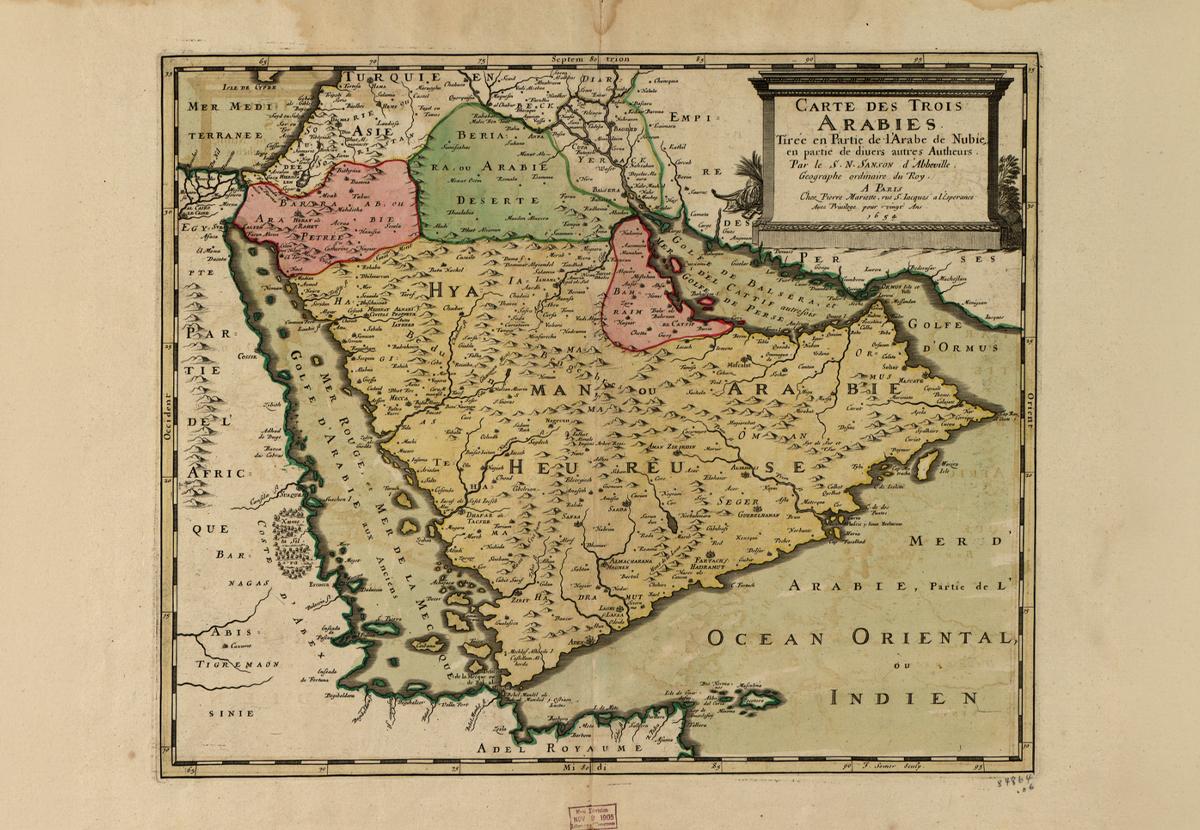
“Map o the Three Arabias”. Excerpted partly of the Arab of Nubia an from several others authors.
Zvonimir Matich
©Zvonimir Matich
©Zvonimir Matich
©Zvonimir Matich