


By: Mohammed Talhaoui and M. Jorge Bolaños Carmona
Islamic ornamental language comes in three fundamental forms: geometric, floral and calligraphic. The geometric form features straight lines as its main element, which we will focus on, as its broken path based on basic angles expresses its message and captures its beauty.
The desirability of reflecting the world without figurative images and of expressing the uniqueness of the divine presence in the universe and, at the same time, its infinity, has led ornamental art with Arabic or Islamic roots to use certain geometric shapes or structures that, through indefinite replication, allow the entire plane to be covered. These ornamental shapes also acquire spiritual or symbolic value as an expression of a world view.
The line, a fundamental element of ornamental art, describes that wordless poetry that has no beginning and no end. It travels through space and time to create infinite forms that induce our gaze into deep contemplation, allowing us to achieve a kind of harmonious union between the heart (the emotional) and reason (the rational).
The aim of our approach is precisely to enable a new focus on the mechanisms and laws that govern this union, expressed through ornamental art. Thus, as we concentrate on this objective, we can perceive the perfection that the line expresses throughout its course.
The Alhambra in Granada, and in general the ornamental elements of the main architectural monuments of the legacy of al-Andalus, are an unbeatable example of the beauty and scientific and technical quality of their intellectual and material creators. The ornamentation of the Alhambra has been extensively studied by specialists in various disciplines, so the aim here is not to analyse its mathematical, architectural or artistic characteristics, but rather to use these ornamental elements to illustrate a methodology for the construction and deconstruction of its elements.
The work we propose to carry out in this approach is to use a rational (mathematical) methodology to develop applications that cover the entire language of the art of geometry. This will allow us to return through the different phases of the conception of the final artistic product to its origin, creating a ‘reverse’ path for all expressions, in order to find the original generating energy.
We hope this will make it easier to interpret ornamental language in its expression of concepts of beauty and aesthetics.
When we think of the art of geometry, we almost always picture intertwined lines. Thus, the eye is invited to travel along this line with no beginning and no end. When faced with expressions of geometric art, we are dazzled not only by its complex nature, but also by the harmony of the arrangement of the lines’ movements, which offer us a beauty in which formal unity is already achieved. It is, in effect, an endless “journey” of the line that intertwine tirelessly.
The reading we propose is to delve into all phases of conception back to its origins, to describe the metamorphosis of geometric language into artistic expression, thereby deciphering any hidden activity. The aim is therefore to develop a generic method for conceiving the art of geometry through a meticulous analysis of the different stages of conception, namely the staging of “angles”, “structures” and “rivers”.
For a better understanding of geometric language, we will analyse it through the following sections:
- The line, a fundamental element of ornamental language.
- On the need for a library of ornamental language.
- Analysis of ornamental language.
- Some case studies.
- Conclusion.
The line, a fundamental element of ornamental language
Ornamental language is based on two synergistic energies, conveyed by lines and represented by straight and curved shapes: two fundamental forms that allow ornamental expression to manifest itself in its entirety. Thus, the straight line reflects the energy of the rational, while the curve expresses that of the emotional, in the manner of a “ying” and “yang” with their own characteristics (also expressing the masculine and the feminine, the singular and the multiple).
These two forms often emerge separately, but they can also sometimes intertwine; here we will focus solely on the energy developed by the straight line, which is expressed in the ‘ornamental language of geometry’. Since the two faculties of human beings—rational and emotional—must function in harmony and synergy, their combination should enable us to gain an enhanced perception of our surroundings and achieve complete fulfilment.
It is in this context that the creativity of the spirit, both intellectual and emotional, is transformed into a tangible product: the line. This exceptional process allows, in a sort of alchemy to translate the geometric laws into artistic expressions.
This approach is in line with this idea, proposing that we develop a new interpretation of ornamental geometric language, as well as revealing the hidden artistic activity that resides within it.
We thus propose a mediating interpretation, situated between the science of geometry, defined by immutable laws, and the genesis of beauty. It offers us this unique opportunity to approach the heart of expression and witness this metamorphosis.
On the necessity of a library of ornamental language
The following chapters will describe the search for the origin of each ornamental representation; once that origin has been found, the complete figure can be reproduced. Various sources produce countless results.
By peeling away the layers of the geometric spaces through which the line travels, we can effectively identify and isolate the laws that scrupulously guide this line on its journey. Each origin and structure determines the final result.
Analysis of ornamental language
In geometric ornamental expression, it is interesting to retain the notion of a ‘period’ that regenerates itself. This idea refers to the module that repeats itself ad infinitum. On the other hand, in the process of ornamental creation, we can distinguish the following phases: the base angles, which will be the angular vocabulary; the origin and birth of the river; the formation of the structure or skeleton; the execution of the river, following the flow of the structure; and the rib or ribbing which is the width of the line.
It should be noted that the entire route of the line is governed by angular language, which is divided into three fundamental spaces or families: the triangle space, the square space, and the pentagon space.
Thus:
The triangle space allows the hexagon to be generated.
The square space allows the creation of an octagon.
The pentagon space develops the decagon.
These spaces will be the matrices that will engender the forms that will allow the different stages described above to find their paths.
Basis angles
The angles are, so to speak, the vocabulary that the line will use in configuring its path and in the genesis of its different movements. A certain number of defined angles are set in the three spaces, which will establish the successive orientations of the line.
In this way, all line movements are performed with reference to the angles corresponding to each space, which are distributed as follows:
Note that the angles of each family are directly related or added together with divisions of 360 degrees, given that they must fit together in the structure; this prevents angles from different families from being mixed, except for the coincidences that can be seen (for example, 90 degrees is an angle common to all three spaces).
The source of the river is located in the space chosen for the creation of the ornament. You must go back to the smallest trace you can find, because this origin is precisely engendered by the traces of each module. This origin is key to replicating the basic figure.
The structure
These ornamental forms also acquire spiritual or symbolic value as an expression of a world view. It is the skeleton that leads to all rivers; the structure is the matrix of every expression. The itineraries of the structures are related to the angles and cells of the ornament. These itineraries will shape the identities of each expression.
The river
This is defined in the figures by two parallel black lines resting on the structure (in blue). The river will be like a coating for the structure and is a fundamental element that shapes the geometric ornamental expression: its origin lies in one of the families mentioned above.
The ribbing
It provides thickness to the line of the river. In its composition, it offers additional complexity and beauty to the geometric expression. The ribbing enhances all the movements created by the vocabulary of angles. Furthermore, it contributes to proportionally reducing the intermediate portions of the plan.
Square space
This line-tracking process offers an infinite number of combinations. It will be seen that the same origin can give rise to different final expressions along its course. Thanks to this ‘angular’ reading, we have been able to create a genealogy of geometric expressions, like a kind of classification table for ornamentation.
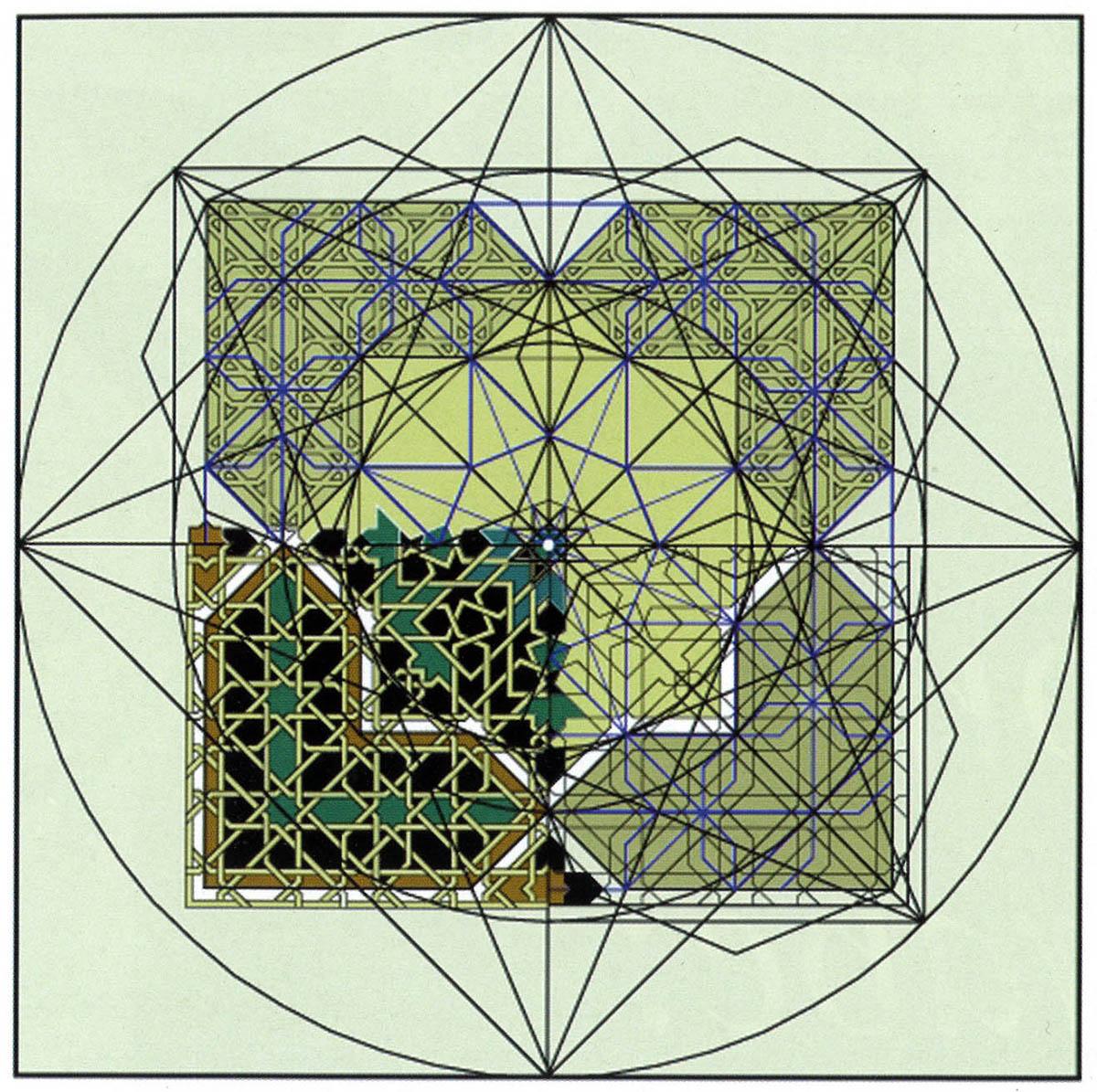
In the following example (Fig. 1), we can see, in a single section, the appearance of different materials such as plaster, zellij (tiles) and wood, as well as the inscription on the muqarnas (stalactites).
Conclusion
The work that can be carried out using this approach employs a rational (mathematical) methodology to develop applications relating to the entire artistic language of geometric ornamentation. This will enable us to trace the different stages from the final product back to its origin, creating a “reverse” path for all expressions, which leads us to generative energy.
From an artistic and cultural point of view, the mechanisms that generate these applications are already imprinted in each case and reading them reveals them as carriers of ornamental language.
Through our study, we hope to reveal the secrets of the hidden activity in this particular type of manifestation of universal human heritage, codifying as best as possible the ‘bridge’ already built between ornamental expression and the path of geometric language.
On the journey that the line takes us on, we can see that its obvious simplicity is paradoxically veiled by the complexity of creation: the smallest is expressed in the largest and vice versa’. What is exceptional is that this view of the line’s path offers an image of the wisdom we all seek within ourselves, attempting to return to the origin of existence through this exercise of searching that the line shows us along its path.
The process of metamorphosis described above reflects an inner mirror in its outcome and gives us the opportunity to seek the center of our origin.
By MOHAMMED TALHAOUI. Researcher in ornamental art from Tlemcen (Algeria) and M. JORGE BOLAÑOS CARMONA. PhD in Mathematics and is a lecturer at the University of Granada.

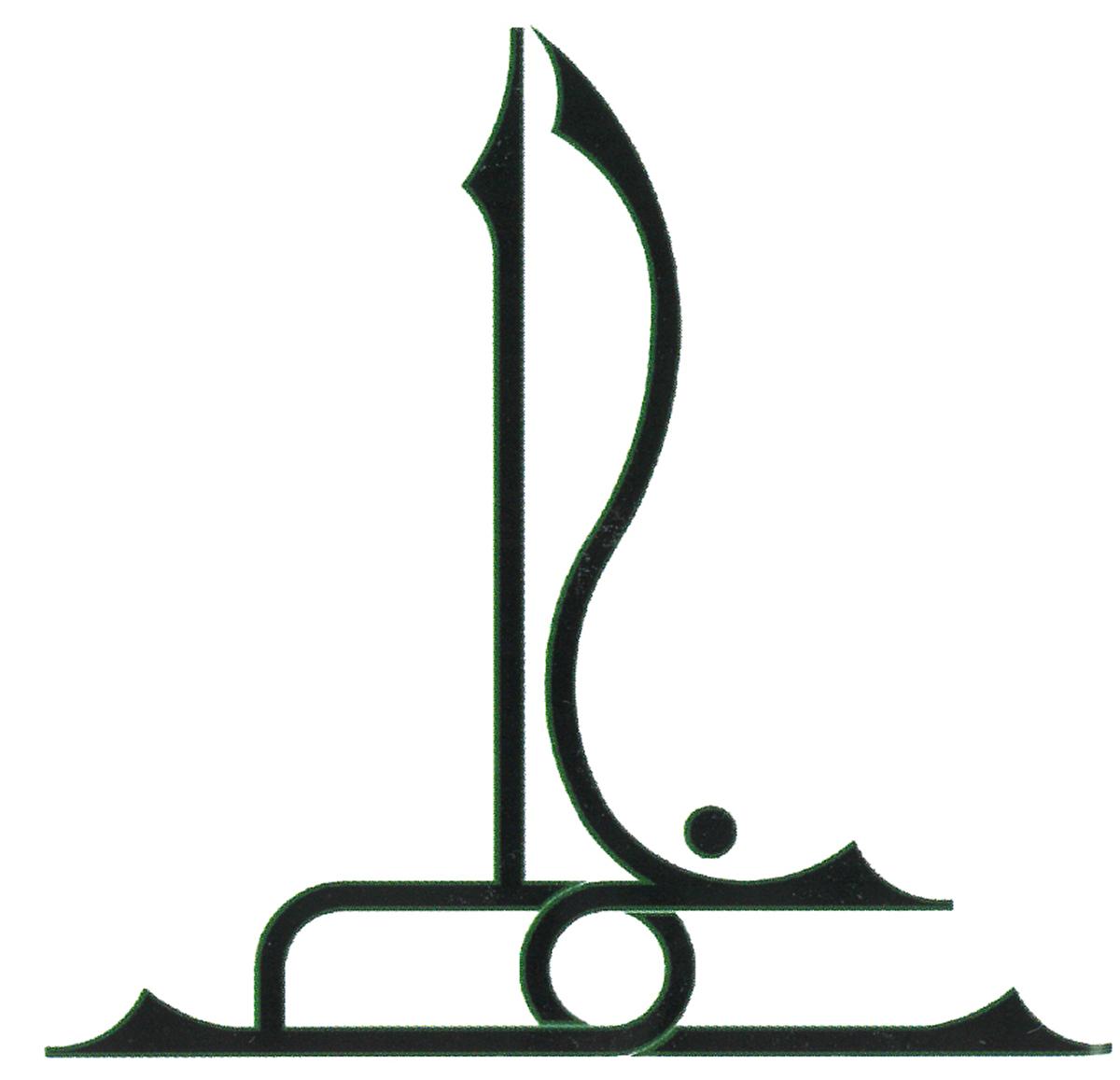
Calligraphic Arabic script of the word ‘khaṭṭ’, meaning ‘line’.
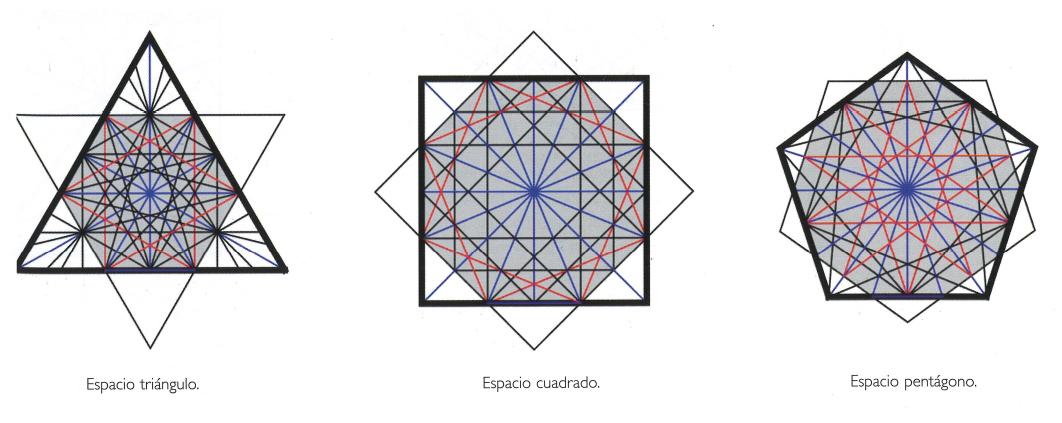
The triangle allows us to form a hexagon, the square creates an octagon, and the pentagon forms a decagon.
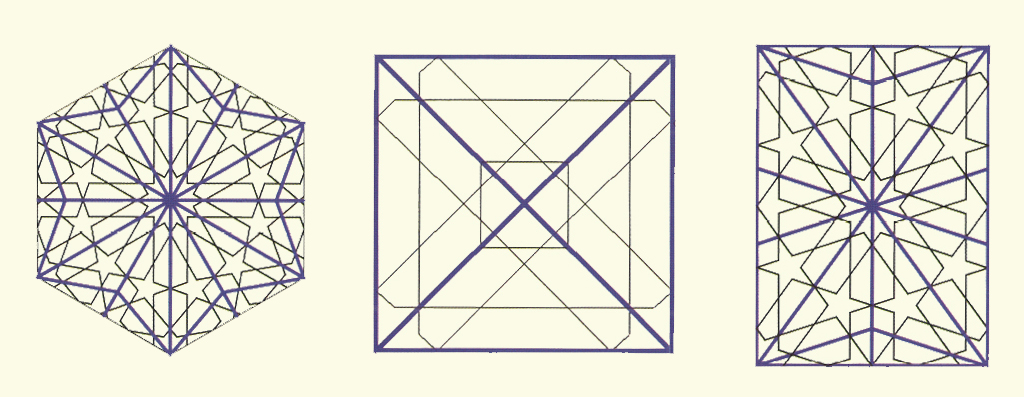
The paths relating to the angles and cells of the ornament are inscribed within the matrix structure of each expression.
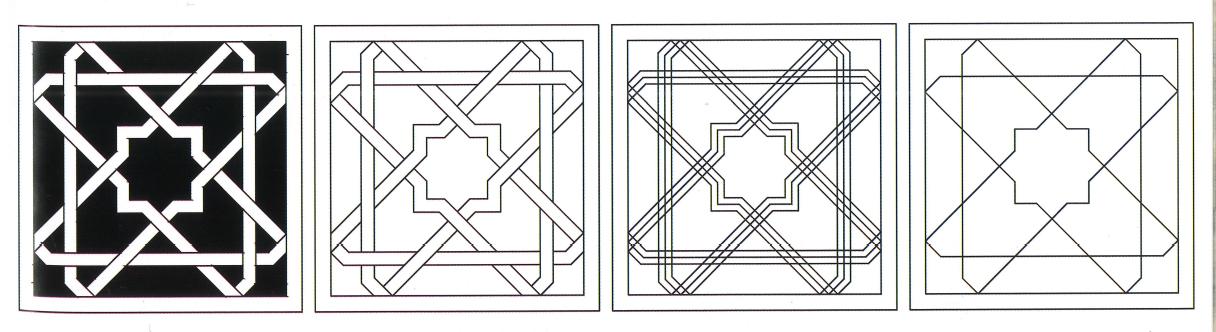
The ribbing accentuates the river’s outline, lending the geometric form greater complexity and beauty.
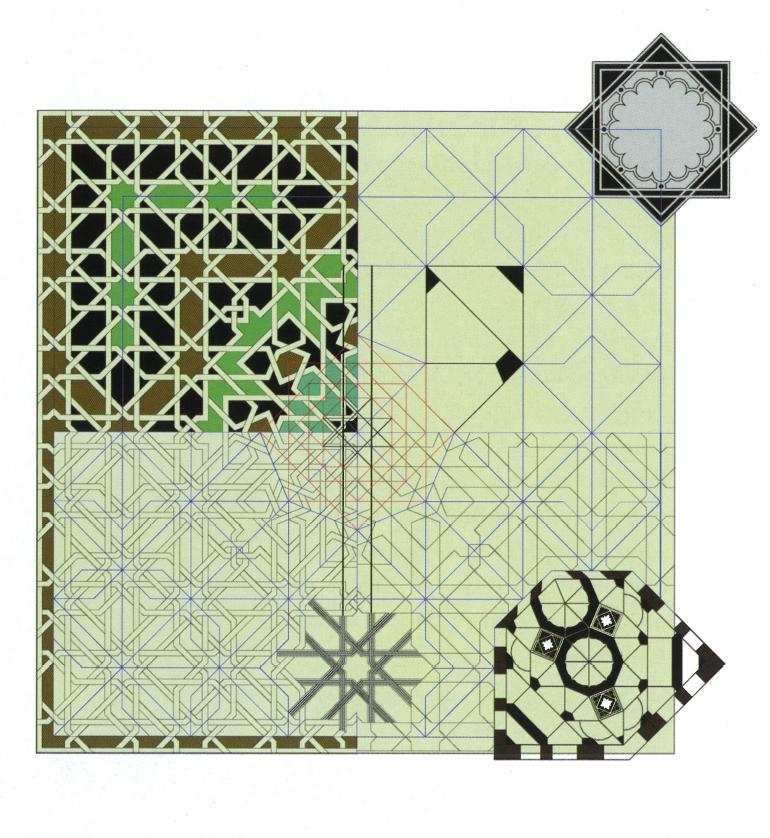
Fig. 1.