


The tomb of King Mausolus, a work for eternity
In memory of Louis Werner (1954-2025)
American journalist filmmaker, and regular contributor to this publication.
En Halicarnaso, la ciudad de la Antigüedad que es en la actualidad Bodrum, en Turquía, existió un excepcional monumento funerario construido en honor al rey Mausolo en el siglo IV a.C. Tal fue la magnitud de la edificación que desde entonces se acuñó el nombre de mausoleo para designar los panteones suntuosos.
King Mausolus, sátrapa[1] satrap of Caria and vassal of Imperial Achaemenid (Persia) governed from 377 to 353 B.C. and he married her sister Artemisia II in this city, making her queen. This singular union resulted in the building of a monument in this city to commemorate their death, for both the power and richness they held in life should be portrayed beyond life in their fabulous tomb.
Another queen named Artemisia formerly existed in the city, from whom historian Herodotus mentioned that “despite being a woman, she fills me with astonishment”. She led a great enterprise when the battle of Salamis took place in the year 480 B.C., where after being attacked by an Athenian trireme, she sank on purpose a friendly boat to save her own life. This made her lord Xerxes, who was watching the course of the battle from such a distance that he could not distinguish allies from foes, to pronounce the famous sentence: “my men behave like women, and my women like men.”
Years later, Artemisia II’s sister, Ada, became queen by marrying Artemisia’s other brother, King Hidrieus, on whom she took revenge when he repudiated her, handing over the city to Alexander the Great during the siege of 334. In a desperate gesture of submission, she asked his permission to adopt him as a son Alexander’s Roman biographer, Arrian, wrote bitterly that he did not reject the offer” after seeing that the city was engulfed by flames.”
All this took place in Halicarnassus, where he word “mausoleum” first appeared, referring to the tomb that Queen Artemisia had built to house her ashes and those of her brother, Mausolus. Antipater of Sidon, the Greek poet who compiled one of the first lists of the Seven Wonders of the Ancient World in the 1st-2nd c. B.C., included the tomb, which in Greek was described as “theamata” (“must-see”).
Such an “unnatural” relationship, to say the least, between brother and sister, was later depicted by the 17th c-Florentine Baroque artist Francesco Furini in his work: Artemisia[2] with the ashes of her husband and brother Mausolus, where the queen appears bare-breasted and with rosy cheeks, feigning a distracted attitude
Bocaccio wrote about Artemisia in his work De Claris Mulieribus, which deals with the biographies of great women in history, that “any receptacle, referring to the place where the king was to be buried would have been inadequate for his ashes except the one where the flame of her love burned”, diplomatically ignoring the fact that they were siblings. There is no doubt that he based this story on that of the 2nd century Roman author Aulas Gellius, who recounted it in a more macabre manner in his book Noctes Atticae (Attic Nights): “inflamed by grief and longing for her husband, she mixed his ashes, ground them into powder, put them in water and drank them… it is said that she gave many other proofs of the violence of her passion.”
According to the Roman writer Vitruvius, “After Mausolus’s death, his wife, Artemisia, became queen, and the inhabitants of Rhodes, who felt outraged that a woman should rule over all the states of Caria, assembled a fleet and sailed until they conquered the kingdom. When the news reached Artemisia, she ordered her fleet to be hidden and the rowers and sailors to gather and hide, while the rest of citizens were to take up their positions on the city wall. When the Rhodians landed, she ordered the people on the walls to welcome them and tell them that they would surrender the city. Then, once they had breached the walls, having left their empty ships moored, Artemisia took the fleet by surprise; she disembarked her soldiers and towed away the empty ships of Rhodians. Thus, after the ambush, the Rhodians had no choice but to flee. They were violently killed in the same forum (public square)”.
The city where this occurred in ancient times is known today as Bodrum, a Turkish word that means −what a coincidence!− “dungeon”, although there is nothing dark or gloomy about this luminous port on the Turkish Riviera, a prestigious centre for luxury tourism. The name Bodrum actually comes from the Latin word Petronium, referring to the castle-fortress known as Saint Peter, which was built in the 15th century by the Crusaders knights of the Order of Saint John to defend the harbour. Stone blocks were used in its construction, which were brought, stone by stone, from the tomb of Mausolus. These had been piled up since they arrived in these places in 1407, when Tamerlane expelled the knights from their castle, which bore the same name −Saint Peter− in Izmir.
Bishop Eustathius of Thessaloniki described the mausoleum as “a marvel” that was still intact at the end of the 12th century, which leads us to believe how close in time this wonder of the Ancient World was, just like the pyramids of Giza, the only ones that have survived from that list. However, we will never know when nor how the mausoleum was reduced to a mere pile of stones, as it was, after all, built in an area of high seismic activity and frequent tidal waves. The neighbouring town of Kos was destroyed by a wave in the year 554, and an earthquake shook the town again on 18 October 1493.
Similarly, we must bear in mind the habitual looting of the monumental treasures of the ancient world that took place in the Middle Ages. Cicero, for example, blames Caius Verres, a Roman governor notorious for corruption, who stole most of his prized statues. In 645, the Arab general Muawiya[3] demolished what remained of the Colossus of Rhodes to sell it, and a Byzantine chronicle from that period notes that he also plundered Halicarnassus. In fact, no coins or pottery fragments have been found near the site where the mausoleum stood, indicating that it had been abandoned for a long time.
The location of Halicarnassus was often confused during the Middle Ages; writers continued to refer to this place in the present tense and as one of the wonders of the world even though it never appeared on any map. It was not mentioned, except as a kind of mythical place of yesteryear, in any manuscript between the years 1000 and 1495, as if it had been swallowed up by the sea, just like Atlantis.
From the Renaissance onwards, when it was ‘rediscovered’ in the works of classical authors, scholars found it amusing to propose hypothetical reconstructions of the mausoleum, to which they attributed a height of 145 metres, spread over five floors. Pliny the Elder left us a detailed second-hand description, providing the names of its architect Pittheus and sculptor Satyro of Paros, while offering measurements that turned out to be inaccurate. Precisely was this regarding the podium: an area measuring 32 by 38 metres made of green stone blocks set in marble. We know now however that the base was square. Above was the pteron, an enclosure of thirty-six Ionic marble columns arranged in rows of nine and eleven, with statues of the king’s family between each one, and adorned with three friezes below depicting important battles, such as that of the Greeks against the Macedonians, another with centaurs, and a third depicting an unidentified event. The third level consisted of a pyramid-shaped structure with 24 steps leading up to the fourth level, a pedestal on which rested the fifth and final element, a quadriga, or chariot, drawn by four horses, carrying the statues of Mausolus and Artemisia. The architectural complex was surrounded by walls measuring 242 by 105 metres.
Also according to Pliny, the most famous sculptors of the time −Scopas, Leochares, Timotheus and Bryaxis− worked individually on the friezes of the four sides and on the statues of the colonnade, and even after the death of Artemisia II, “they did not stop working, as they considered it to be both a monument in her honour and a tribute to the art of the sculptors”.
The first modern archaeologist of Halicarnassus, the Englishman Charles Thomas Newton, found several panels from a frieze and statues while working at the site in 1857, including a 3-metre-tall statue of a man, which he thought might be Mausolus himself. They are now in the British Museum. During other expeditions carried out later by a Danish team led by Kristian Jeppesen, some 70 lion statues and 250 human figures were brought to the surface. Many of them were found outside the mausoleum, which lead us to believe that they were dragged by a seismic movement.
Newton’s interpretation of the mausoleum’s possible appearance later served as a model for numerous historic buildings, such as the Grand Tomb (1897) in New York, the Shrine of the Fallen (1928) in Melbourne, and the Masonic Temple (1915) in Washington. The design of St George’s Church in the London borough of Bloomsbury is directly inspired by Pliny’s description.
Vitruvius describes other buildings in Halicarnassus that have completely disappeared, such as the palace “entirely decorated with marble from the quarry at Proconnesus” (the Turkish island of Marmara), whose brick walls, which still today endure, were covered with “stucco so polished that it shone like glass”, the sanctuary dedicated to Mars “with a colossal statue made by the famous Leochares” and the temple of Mercury.
The Knights of the Order of Saint John arrived in Halicarnassus in 1407 and found the tombs already in ruins. “One of these knights, writing shortly after the Kos earthquake of 1493, reported that it might have affected Halicarnassus, and that the mausoleum had been “saved from the fury of the barbarians because it was hidden among the ruins of the city.” He went on to describe the discovery of the burial chamber inside: “First we came across some stairs leading down to the underground burial site, and when we reached it, we were breathless at the spectacular sight before our eyes. A moment later, we began to loot the place, but we did not have much time because we received orders to return to the castle. The day after, when we returned to the same place, we found precious gold jewellery and pieces of fine fabric scattered everywhere.”
The Knights Templar, in an unforgivable act, simply ground up and burned the marble blocks to obtain mortar. Thus, it could be said that the binding agent that keeps their castle standing today was obtained from the ‘skeletal structure’ of the mausoleum that once housed the bones of King Mausolus himself.
In April 1989, an extraordinary archaeological discovery was made in Bodrum: the tomb of a richly adorned forty-year-old woman wearing a gold tiara, necklace, rings and bracelets, now known as the ‘Carian Princess’ whose bones have been dated between 360 and 325 BCE. Could this be Queen Ada, who surrendered her city to Alexander?
Another discovery, that of a beautifully adorned woman from the mid-4th century BCE, practically puts an end to the story that tells of a mysterious disappearance of another beautiful statue of a naked woman from the same period: the one known as the Aphrodite of Knidos. It was the first freestanding Greek statue, completely nude, sculpted by the great sculptor Praxiteles, which was displayed in the temple dedicate to Aphrodite Euploia −the goddess of safe travel− just across the narrow Ceramicus Sinus (now the Gulf of Gökova) in the neighbouring Greek colony of Knidos.
Pilgrims never stopped coming from Knidos, Halicarnassus and the rest of places in the Carian coast. Many arrived aboard those marvellous two-masted wooden vessels known by Turkish word gullet.
The renowned Polish journalist Ryszard Kapuscinsky (1932-2007), while he visited these places to document his latest book Travels with Herodotus, recounted that, in the Museum of Underwater Archaeology, in the Castle of Saint Peter, he found “a fragment of the unfathomable underwater world, whose depths are as rich and varied as the kingdom on its surface. There are sunken islands down there, and on them submerged villages and towns, ports and moorings, temples and sanctuaries, altars and statues… there are sunken boats and pirate ships… Phoenician galleys, the great fleets of the Persians … countless herds of horses, flocks of goats and sheep, forests and farmland, vineyards and olive groves… the world that Herodotus knew”.
From all the features of the castle only a fragment of the mausoleum statuary remains, since all the rest has disappeared. However, whenever it takes place, now or in the future, or wherever the remains of a dictator, or a president, or any illustrious person rest in a mausoleum, one could well look back and take note of King Mausolus of Halicarnassus, and how Herodotus described for posterity the battle of man to preserve his works from decay or destruction.
In memory of Louis Werner (1954-2025)
American journalist filmmaker, and regular contributor to this publication.
[1] The satraps were directly appointed by kings from nobility as leaders or local rulers in the empires of the ancient world, whose main predicament was their loyalty to the emperor or monarch.
[2] The painting shows Artemisia holding a golden cup with the beverage containing part of the ashes of her husband and brother, Mausolus, ready for the drinking of the mixture to make her body a living tomb.
[3] Muawiya ibn Abi Sufyan was the founder of the Umayyad Caliphate and its first Caliph.

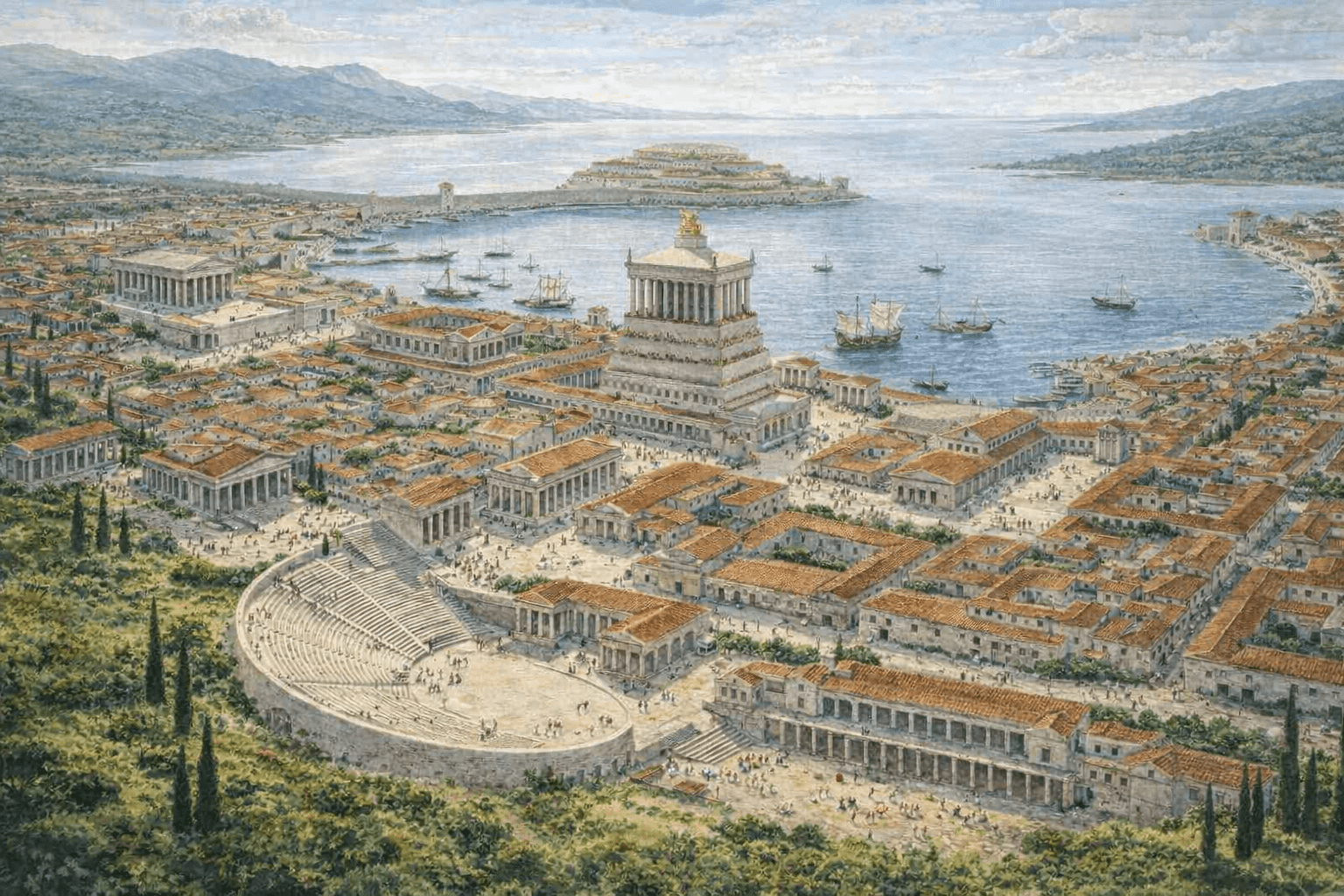
AI recreation of the city of Halicarnassus based on the work of ©Balage Balog.
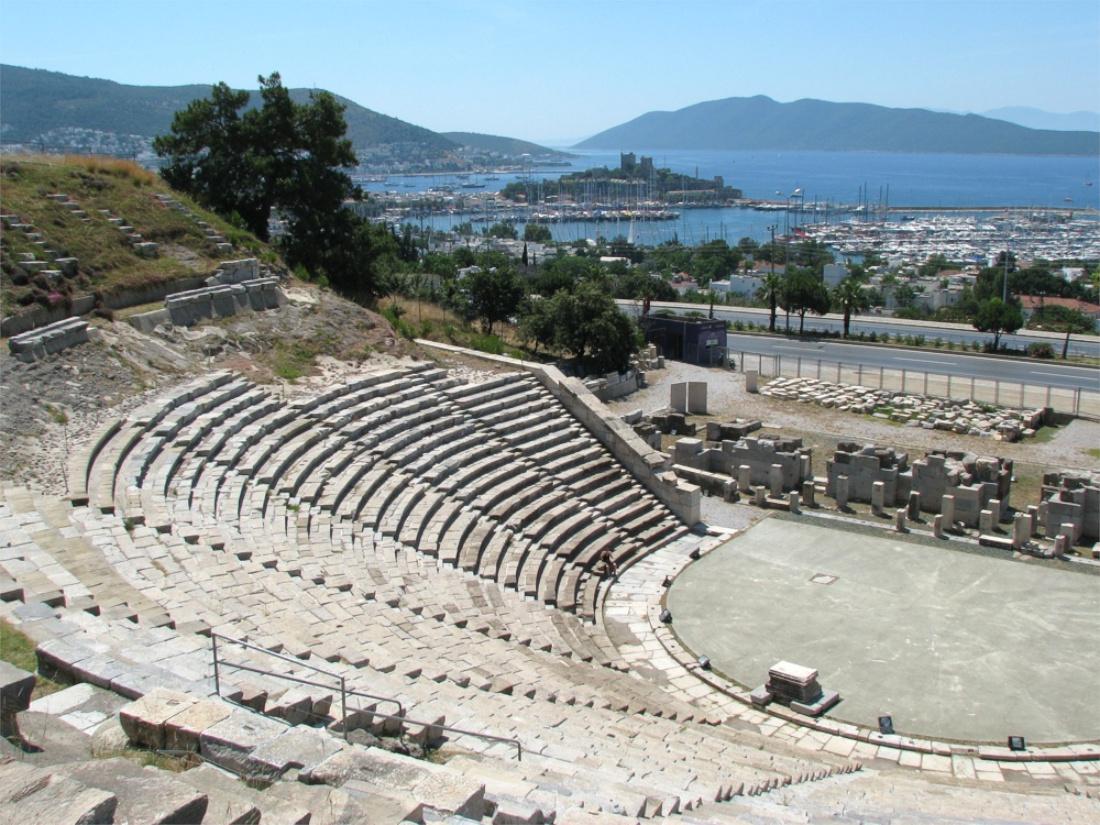
Roman Theatre in Bodrum, on the Turkish coast of the Aegean Sea.
Although its original construction took place in the 4th century BC, it was expanded in the 2nd century by the Romans. It is one of the best-preserved buildings of ancient Halicarnassus.
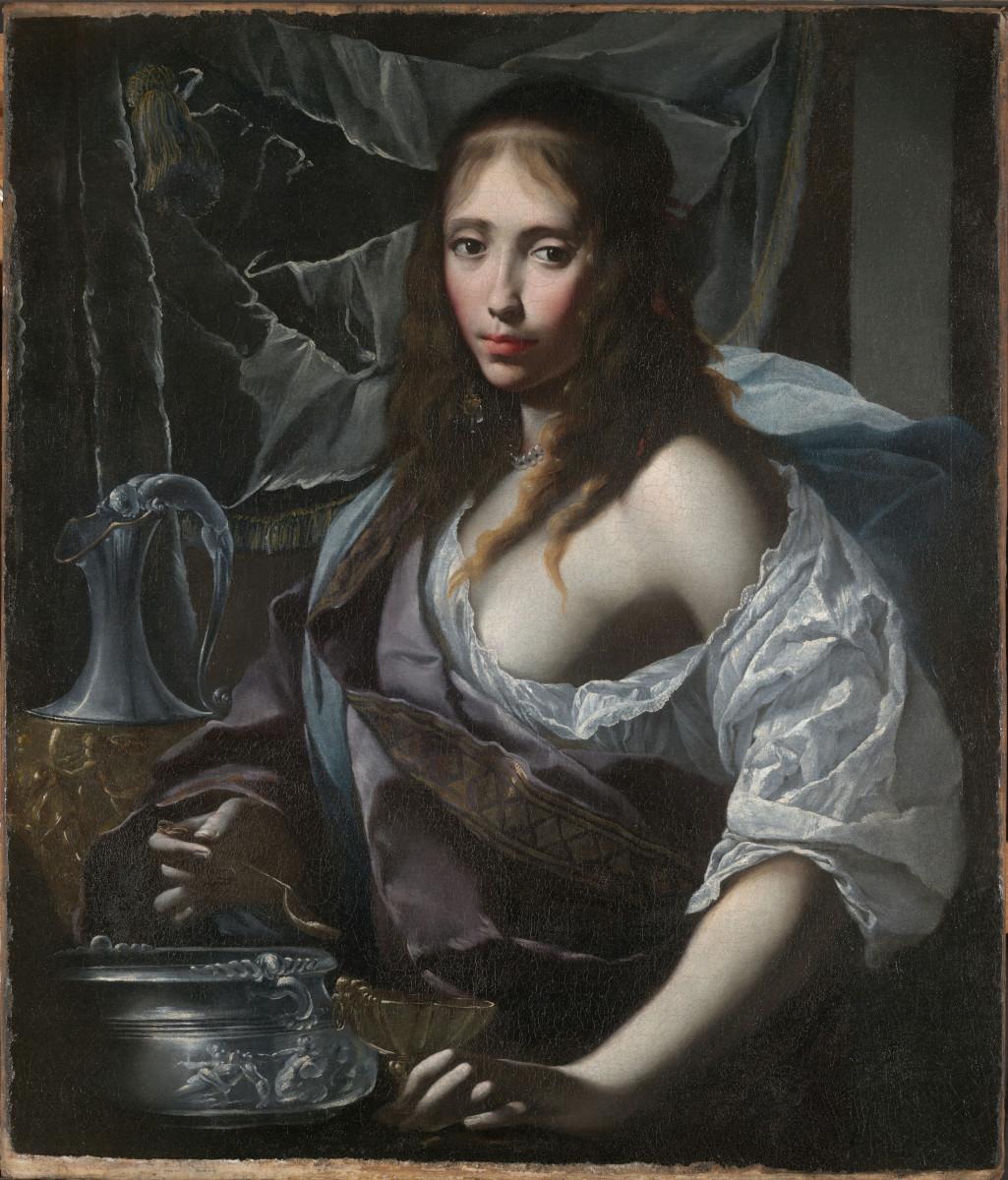
Artemisia with the ashes of her husband and brother Mausolus, oil painting by the 17th-century Florentine Baroque artist Francesco Furini.
The painting shows Artemisia holding a golden cup with the beverage containing part of the ashes of her husband and brother, Mausolus, ready for the drinking of the mixture to make her body a living tomb.
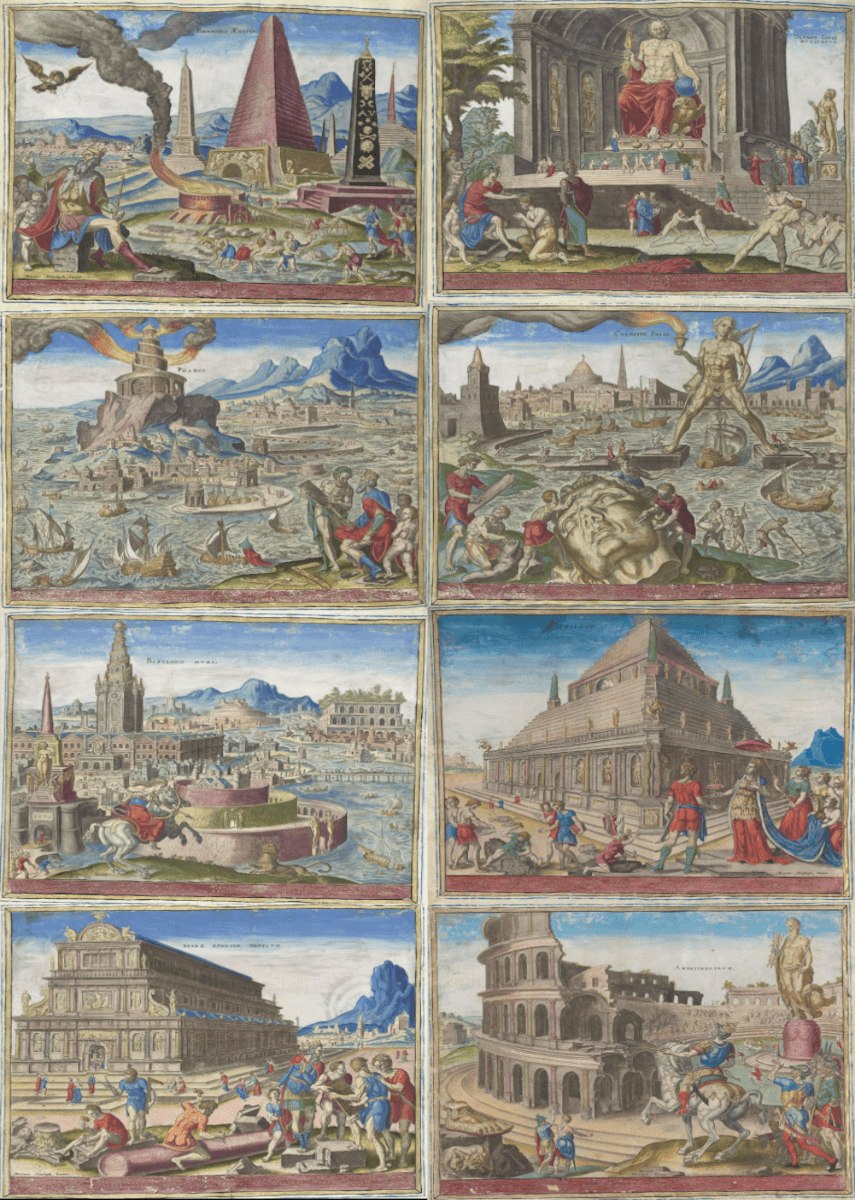
The Seven Wonders of the Ancient World.
According to the list compiled by Philo of Byzantium and Antipater of Sidon: the Great Pyramid of Giza, the Hanging Gardens of Babylon, the Temple of Artemis at Ephesus, the Statue of Zeus at Olympia, the Mausoleum at Halicarnassus, the Colossus of Rhodes, and the Lighthouse of Alexandria.
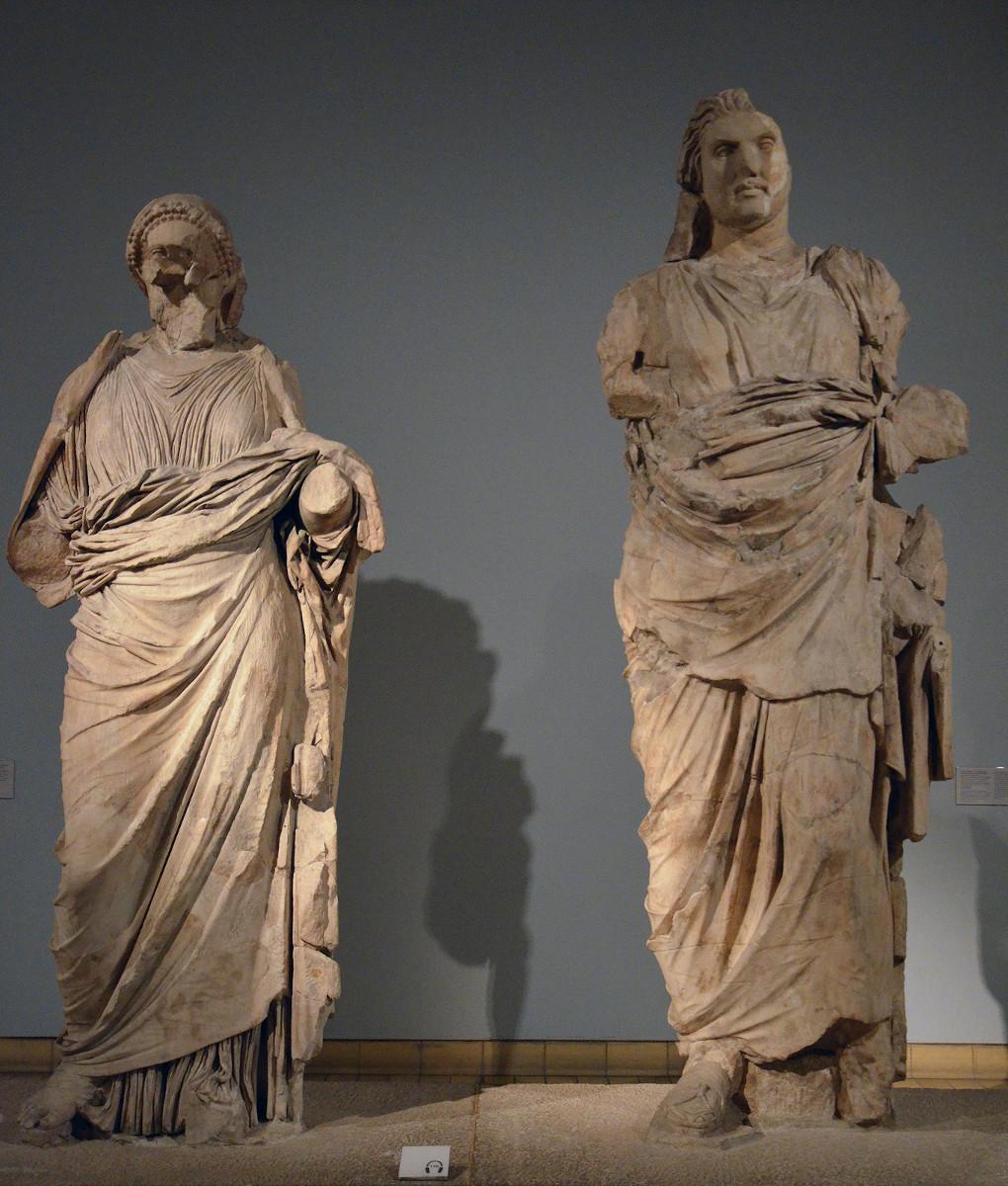
Statues of Artemisia II and Mausolus, exhibited at the British Museum (London).
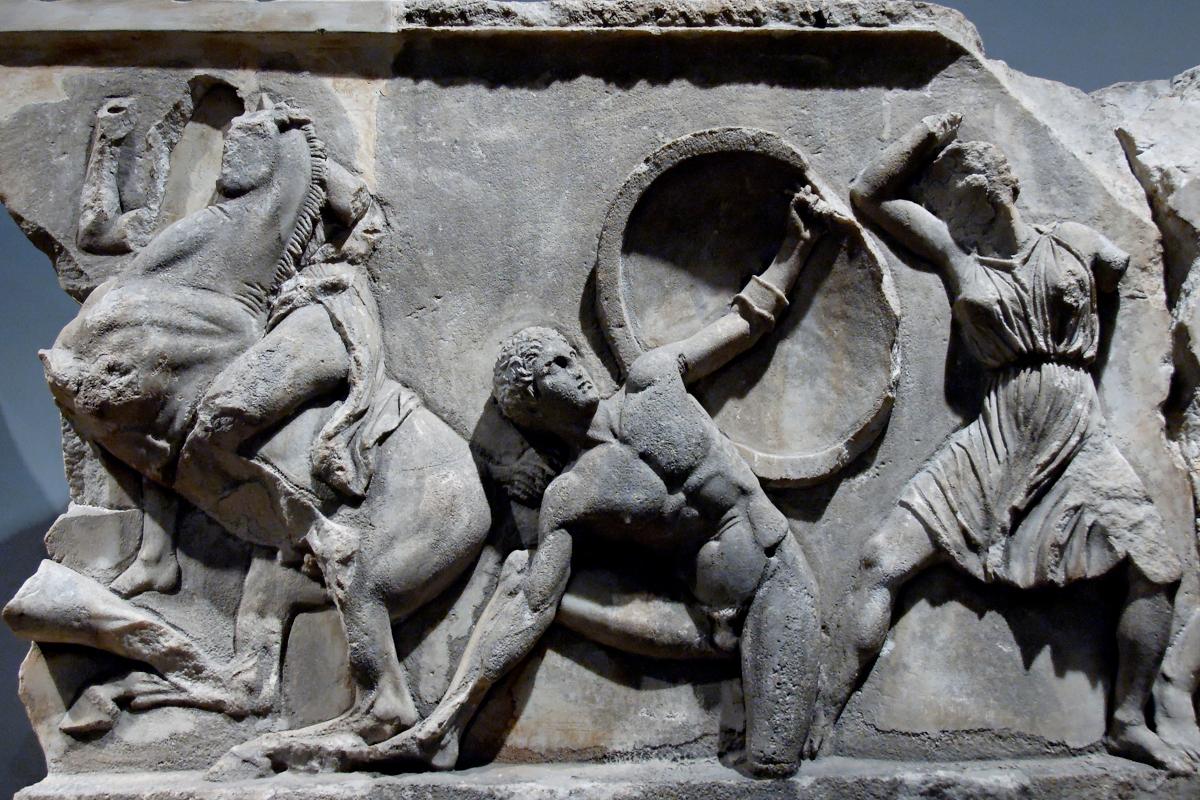
Frieze depicting a battle scene with the Amazons that decorated the perimeter base of the monument. ©Trustees of the British Museum.
The ornamental elements of the mausoleum were crafted by the finest artists of their time, such as Scopas of Paros, Timotheus, Leochares and Bryaxis.
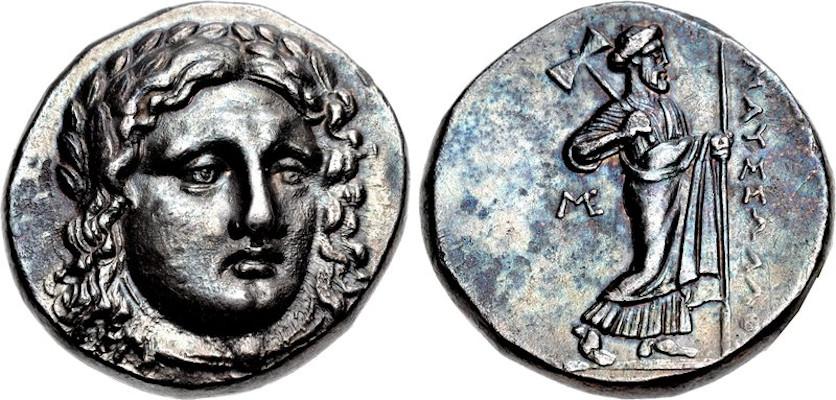
Monedas (tetradracmas) acuñadas durante el reinado de Mausolo, como sátrapa de Caria, entre el 377 y el 352 a.C.